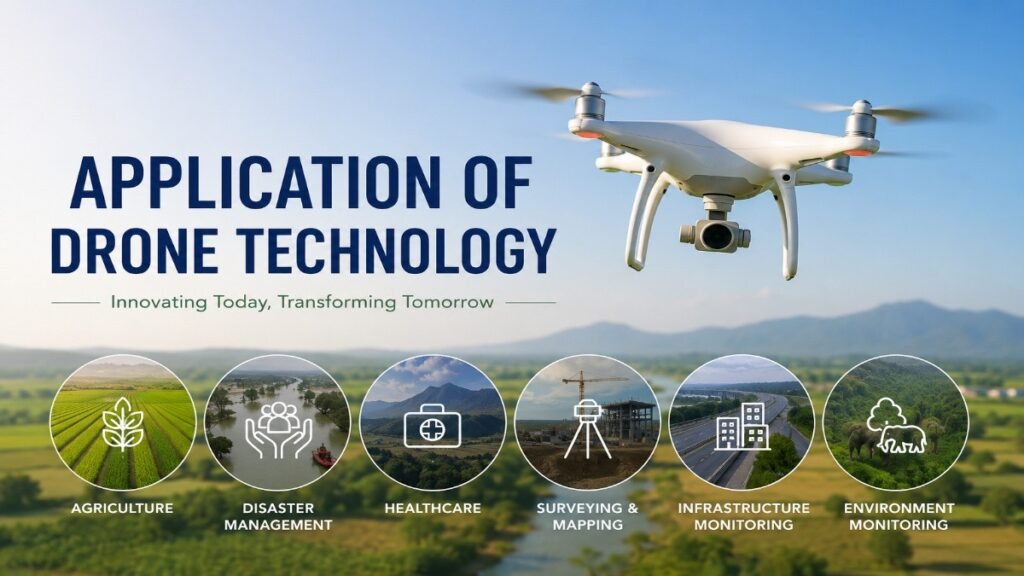
1. Introduction
A Drone, also known as an Unmanned Aerial Vehicle (UAV), is an aircraft that operates without a human pilot on board. It is either controlled remotely by an operator or flies autonomously using pre-programmed instructions, sensors, GPS and Artificial Intelligence (AI). A drone, along with its control station, communication system and supporting equipment, is collectively known as an Unmanned Aircraft System (UAS).
Initially developed for military reconnaissance and surveillance, drone technology has rapidly expanded into civilian sectors such as agriculture, healthcare, disaster management, infrastructure development, logistics, environmental monitoring and governance. The growing application of drone technology across these sectors has made drones an important tool for improving efficiency, reducing costs and enhancing public service delivery.
Recognising its transformative potential, the Government of India has introduced several initiatives, including the Drone Rules, 2021, Drone (Amendment) Rules, 2022, Drone Shakti Initiative, and the Namo Drone Didi Scheme, to promote indigenous manufacturing and wider adoption of drones. These policy measures have significantly accelerated the growth of drone technology in India by encouraging innovation, private investment and domestic manufacturing.
Today, drone technology is emerging as a key component of Digital India, Atmanirbhar Bharat and Viksit Bharat 2047, contributing to economic growth, improved public service delivery and enhanced national security. These Drone Technology for BPSC notes provide a comprehensive understanding of the concept, evolution and application of drone technology, making them highly useful for BPSC Mains and other competitive examinations.
Master Science & Technology. Maximize Your BPSC Mains Score.
Enroll in the BPSC Science & Tech Course Today
Master Science & Technology for BPSC Mains GS Paper-2 with 75+ exam-oriented topics, 6 structured lessons, and downloadable PDF notes—all in one course.
✔ 75+ Exam-Oriented Topics • ✔ 6 Comprehensive Lessons • ✔ Downloadable PDF Notes • ✔ Updated for 72nd BPSC Mains
2. Types of Drones
Drone technology can be classified on the basis of design, weight and purpose. Each type is suited for specific operational requirements depending on factors such as flight duration, payload capacity, manoeuvrability and area of application. Understanding these classifications is important for appreciating the diverse application of drone technology across civilian and military sectors.
Based on Design
- Fixed-Wing: Long-range drones used for surveillance, mapping and border monitoring.
- Multi-Rotor: The most common drones (e.g., quadcopters) used for photography, agriculture and infrastructure inspections.
- Single-Rotor: Helicopter-like drones capable of carrying heavier payloads.
- VTOL (Vertical Take-Off and Landing): Combine the advantages of fixed-wing and rotor-based drones for long-endurance missions.
Based on Weight (Drone Rules, 2021)
- Nano: Up to 250 g
- Micro: 250 g–2 kg
- Small: 2–25 kg
- Medium: 25–150 kg
- Large: Above 150 kg
Based on Purpose
- Civilian Drones: Used in agriculture, healthcare, logistics, surveying, disaster management, environmental monitoring and other developmental activities.
- Military Drones: Used for surveillance, reconnaissance, intelligence gathering and combat operations.
The wide variety of drone types reflects the rapidly expanding scope of drone technology across multiple sectors. From precision farming and infrastructure inspection to defence and disaster response, the classification of drones helps in selecting the most suitable platform for specific tasks. These concepts form an important part of Drone Technology for BPSC and provide the foundation for understanding the application of drone technology and the growing role of drone technology in India.
3. Evolution of Drone Technology in India
- 1990s: India began using Unmanned Aerial Vehicles (UAVs) after procuring reconnaissance drones from Israel for surveillance purposes. This marked the beginning of drone technology in India for defence and strategic applications.
- Kargil War (1999): UAVs were extensively used for Intelligence, Surveillance and Reconnaissance (ISR) along the Line of Control (LoC), highlighting their strategic importance and demonstrating the military application of drone technology.
- Expansion to Civilian Use: Over time, drone technology found applications in agriculture, infrastructure monitoring, disaster management, healthcare, mining and logistics, significantly expanding its role beyond defence.
- Regulatory Framework: The Directorate General of Civil Aviation (DGCA) regulates drone operations in India through the Drone Rules, 2021, supported by the Digital Sky Platform, providing a simplified and transparent regulatory ecosystem.
- Indigenous Development: Under Atmanirbhar Bharat, India is promoting domestic drone manufacturing through initiatives such as the PLI Scheme, Drone Shakti Initiative, and Namo Drone Didi Scheme, making drones a key component of the country’s technology ecosystem.
The evolution of drone technology in India reflects the country’s transition from limited military usage to widespread civilian and commercial adoption. Today, the application of drone technology spans multiple sectors, including agriculture, governance, healthcare and disaster management, making these developments an important part of Drone Technology for BPSC and other competitive examinations.
Prepare Smarter. Study Better. Ace BPSC Mains.
BPSC Mains GS Paper 1 & 2 Complete Course
Access comprehensive BPSC Mains Notes for GS Paper 1 & 2, covering 378+ topics across 24 PDF lessons, with dedicated Bihar coverage, practice questions and downloadable study material.
✓ GS Paper 1 & 2 • ✓ 378+ Topics • ✓ 24 PDF Lessons • ✓ Bihar-Specific Coverage • ✓ Downloadable Notes
4. Applications of Drone Technology
Agriculture and Precision Farming
Drone technology is transforming Indian agriculture through precision farming, where crops are monitored and managed using real-time aerial data. Drones are used for crop health monitoring, precision spraying of pesticides and fertilisers, seed broadcasting, irrigation assessment and yield estimation, helping reduce input costs while increasing productivity. Under the Namo Drone Didi Scheme (2023), the Government aims to empower 15,000 Women Self-Help Groups (SHGs) by providing drones for agricultural services. The Ministry of Agriculture has also notified Standard Operating Procedures (SOPs) for drone use in pesticide application, making agriculture one of the fastest-growing sectors for the application of drone technology in India.
Defence and Internal Security
Drones have become a force multiplier for India’s Armed Forces by enhancing Intelligence, Surveillance and Reconnaissance (ISR) capabilities. They are deployed for border surveillance, anti-terror operations, monitoring infiltration, target acquisition and battlefield assessment along the Line of Control (LoC) and Line of Actual Control (LAC). During recent border tensions, drone technology in India has been extensively used for surveillance in Ladakh, while security forces also employ anti-drone systems to counter cross-border drone intrusions and arms smuggling, particularly along the India-Pakistan border.
Disaster Management
Drones enable rapid assessment of disaster-affected areas without risking human lives. They are used for search and rescue operations, flood mapping, damage assessment, delivery of relief materials and locating stranded victims during floods, landslides, cyclones and earthquakes. During floods in Assam, Bihar and Kerala, drones have assisted the National Disaster Response Force (NDRF) in identifying affected areas and planning rescue operations more efficiently. This is one of the most important applications of drone technology in disaster response.
Healthcare and Medical Services
Drones improve healthcare accessibility in remote and inaccessible regions by transporting vaccines, blood, medicines and diagnostic samples within a short time. Under the ‘Medicine from the Sky’ initiative, pilot projects in Telangana, Arunachal Pradesh and Meghalaya have successfully demonstrated drone-based delivery of medical supplies to difficult terrains. This technology proved particularly useful during the COVID-19 pandemic for delivering essential healthcare materials.
Surveying, Mapping and Land Records
Drone technology has significantly improved the accuracy and speed of land surveys, cadastral mapping, urban planning and infrastructure monitoring. It plays a crucial role in the SVAMITVA Scheme, under which drone surveys are conducted to prepare property cards for rural households, reducing land disputes and improving property ownership records. High-resolution drone imagery is also widely used in highway, railway and smart city projects.
Infrastructure Development and Mining
Government agencies and private companies use drones to monitor the construction of roads, bridges, railways, power transmission lines, pipelines and dams. In the mining sector, drones help in mine planning, volumetric analysis, environmental compliance and safety inspections, reducing operational costs while improving efficiency.
Logistics and E-commerce
Drone-based logistics has emerged as a promising solution for last-mile delivery, particularly in rural and inaccessible regions. Companies are testing drones for delivering medicines, essential goods and e-commerce packages, significantly reducing delivery time and transportation costs. India is also exploring Beyond Visual Line of Sight (BVLOS) drone operations to expand commercial delivery services.
Environment and Wildlife Conservation
Drones assist in forest monitoring, wildlife census, anti-poaching operations, pollution monitoring and disaster prediction. They are used by forest departments to monitor protected areas such as Kaziranga National Park and Corbett Tiger Reserve, while environmental agencies employ drones to detect illegal mining, forest encroachments and air pollution hotspots.
Governance and Law Enforcement
Government agencies increasingly use drones for traffic management, election monitoring, crowd surveillance, law and order maintenance and monitoring public infrastructure projects. During major events such as the Kumbh Mela, Republic Day celebrations and election rallies, drones provide real-time aerial surveillance, improving public safety and administrative efficiency.
Applications in Bihar
Bihar has gradually adopted drone technology for land surveys under the SVAMITVA Scheme, crop monitoring, flood management in the Kosi and Gandak river basins, infrastructure inspection and disaster response. The state government is also promoting drone-based agricultural services and skill development through partnerships with educational institutions and private agencies, creating new employment opportunities in the emerging drone sector.
The expanding application of drone technology across agriculture, defence, healthcare, governance and disaster management demonstrates its transformative potential in driving socio-economic development. The rapid adoption of drone technology in India makes this topic highly relevant for Drone Technology for BPSC and other competitive examinations.
5. Government Initiatives and Policy Framework
- Drone Rules, 2021: Replaced the restrictive 2018 regulations with a simplified framework. The rules reduced compliance requirements, classified drones by weight, permitted operations up to 400 feet, and introduced an interactive airspace map with Green, Yellow and Red Zones. These reforms have significantly accelerated the adoption of drone technology in India.
- Drone (Amendment) Rules, 2022: Simplified the process of obtaining a Remote Pilot Certificate by authorising DGCA-recognised Remote Pilot Training Organisations (RPTOs), thereby promoting the availability of skilled drone pilots and strengthening the ecosystem for the application of drone technology.
- Digital Sky Platform: An online platform developed by the Directorate General of Civil Aviation (DGCA) for drone registration, pilot certification, flight permissions and airspace management under the “Ease of Doing Business” approach.
- PLI Scheme for Drones (2021): A ₹120 crore Production Linked Incentive (PLI) Scheme was launched to promote indigenous drone and drone component manufacturing under Atmanirbhar Bharat, encouraging innovation and strengthening domestic manufacturing capabilities.
- Drone Shakti Initiative (2022): Announced in the Union Budget 2022–23 to promote Drone-as-a-Service (DrAAS) and encourage drone start-ups, skilling and industrial applications, thereby expanding the commercial use of drone technology.
- Namo Drone Didi Scheme (2023): Aims to provide drones to 15,000 Women Self-Help Groups (SHGs) for agricultural services, improving farm productivity while generating rural employment and enhancing women’s economic empowerment.
These policy initiatives have created a supportive regulatory and institutional framework for the growth of drone technology in India. By encouraging innovation, indigenous manufacturing, skill development and wider commercial adoption, the Government has laid the foundation for a robust drone ecosystem. These developments form an important part of Drone Technology for BPSC and are frequently asked while discussing the application of drone technology in competitive examinations.
6. Challenges Associated with Drone Technology
Security Threats and Terrorism
The misuse of drone technology for terrorism, cross-border infiltration, espionage and smuggling has emerged as a major security concern for India. A notable example was the drone attack on the Indian Air Force Station at Jammu on 27 June 2021, the first such attack on an Indian military installation, where explosive-laden drones targeted the airbase. Drones have also been repeatedly used along the India-Pakistan border to drop arms, ammunition, explosives, narcotics and counterfeit currency, posing serious challenges to national security. Addressing these threats is essential for the safe expansion of drone technology in India.
Privacy and Cybersecurity Risks
Equipped with high-resolution cameras and sensors, drones can be misused for unauthorised surveillance, violating the privacy of individuals and sensitive installations. They are also vulnerable to GPS spoofing, signal jamming, hacking and data theft, which can compromise military and civilian operations. As the application of drone technology becomes increasingly digital, cybersecurity has emerged as a critical concern.
Technical and Operational Limitations
Most commercial drones have limited battery life (typically 20–60 minutes), restricted payload capacity and shorter operational ranges. Their performance is adversely affected by strong winds, heavy rainfall, fog and extreme temperatures, limiting their effectiveness in difficult terrains and adverse weather conditions.
Regulatory and Airspace Challenges
The rapid increase in drone usage has made airspace management more complex. Preventing collisions with manned aircraft, ensuring compliance with DGCA regulations and monitoring unauthorised drone operations require robust surveillance systems and effective implementation of the Digital Sky Platform.
Economic and Infrastructure Constraints
Advanced drones, sensors and anti-drone systems involve high acquisition and maintenance costs, making them less affordable for small farmers and start-ups. In addition, drone technology in India still requires greater investment in drone manufacturing, maintenance facilities, skilled manpower and research & development to achieve self-reliance.
Ethical and Legal Concerns
The increasing use of autonomous drones raises concerns regarding accountability, data ownership and the ethical use of Artificial Intelligence (AI). Clear legal provisions are required to regulate drone operations while ensuring public safety, privacy and responsible innovation.
These challenges indicate that while drone technology offers immense developmental and strategic opportunities, its sustainable growth depends on balancing innovation with security, regulation and ethical safeguards. Addressing these issues will be crucial for expanding the application of drone technology across sectors and realising the full potential of drone technology in India. These topics are highly relevant for Drone Technology for BPSC and other competitive examinations.
7. Future Prospects
- AI and Autonomous Drones: The integration of Artificial Intelligence (AI), Machine Learning (ML) and computer vision will enable autonomous navigation, real-time decision-making and intelligent surveillance, significantly expanding the capabilities of drone technology.
- Drone Swarms and Defence Applications: India is developing drone swarm technology for coordinated surveillance, electronic warfare and precision strikes, enhancing the operational capabilities of the Armed Forces. This represents an important future application of drone technology in national security.
- Expansion of Commercial Services: Drone-based delivery of medicines, agricultural inputs, e-commerce parcels and emergency supplies is expected to expand rapidly, particularly in remote and inaccessible regions, making drone technology in India more commercially viable.
- Boost to Indigenous Manufacturing: Government initiatives such as the PLI Scheme, Drone Shakti Initiative and Make in India are expected to strengthen India’s drone ecosystem, promote exports and generate large-scale employment opportunities.
- Role in Viksit Bharat 2047: With advancements in 5G, GIS, Internet of Things (IoT) and smart city technologies, drone technology is expected to become an integral part of governance, agriculture, infrastructure development, disaster management and public service delivery.
The future of drone technology in India lies in the convergence of artificial intelligence, automation, digital infrastructure and indigenous innovation. As technology advances and supportive government policies continue, the application of drone technology is expected to expand across almost every sector of the economy, contributing significantly to Atmanirbhar Bharat, Digital India and Viksit Bharat 2047. These developments make Drone Technology for BPSC an important topic for BPSC Mains and other competitive examinations.
8. Conclusion
Drone technology has emerged as a transformative tool with applications ranging from defence and internal security to agriculture, healthcare, disaster management and governance. The wide application of drone technology across these sectors has improved efficiency, reduced operational costs and strengthened public service delivery, making drones an integral part of India’s digital transformation.
With supportive policies such as the Drone Rules, 2021, PLI Scheme, Drone Shakti Initiative and Namo Drone Didi Scheme, drone technology in India is rapidly evolving into a robust indigenous ecosystem driven by innovation, start-ups and private sector participation. By addressing challenges related to security, privacy, regulation and infrastructure, drone technology has the potential to make a significant contribution to Atmanirbhar Bharat, Digital India and Viksit Bharat 2047. These Drone Technology for BPSC notes provide a comprehensive understanding of the concept, applications and future prospects of drones, making the topic highly relevant for BPSC Mains and other competitive examinations.
Learn More from DGCA:
Readers interested in understanding drone technology, the Drone Rules, 2021, Digital Sky Platform, airspace classification, pilot certification, drone registration and the latest regulatory framework for drone technology in India can visit the Directorate General of Civil Aviation (DGCA) – Drones Portal. It provides authentic information on drone regulations, licensing, operational guidelines and policies governing the application of drone technology in India.
BPSC Mains Practice Questions
Q1. “Drone technology has emerged as a transformative tool for socio-economic development and national security in India.” Discuss the major applications of drone technology in agriculture, disaster management, healthcare, governance and defence. Also examine the government initiatives promoting drone technology in India.
Q2. Examine the regulatory framework governing drone technology in India. Discuss the significance of the Drone Rules, 2021, Digital Sky Platform, PLI Scheme, Drone Shakti Initiative and Namo Drone Didi Scheme in promoting indigenous drone manufacturing and innovation.
Q3. Discuss the major challenges associated with drone technology in India, including security, privacy, cybersecurity and regulatory concerns. Suggest suitable measures to ensure the safe, responsible and widespread adoption of drone technology in the country.