1. Introduction
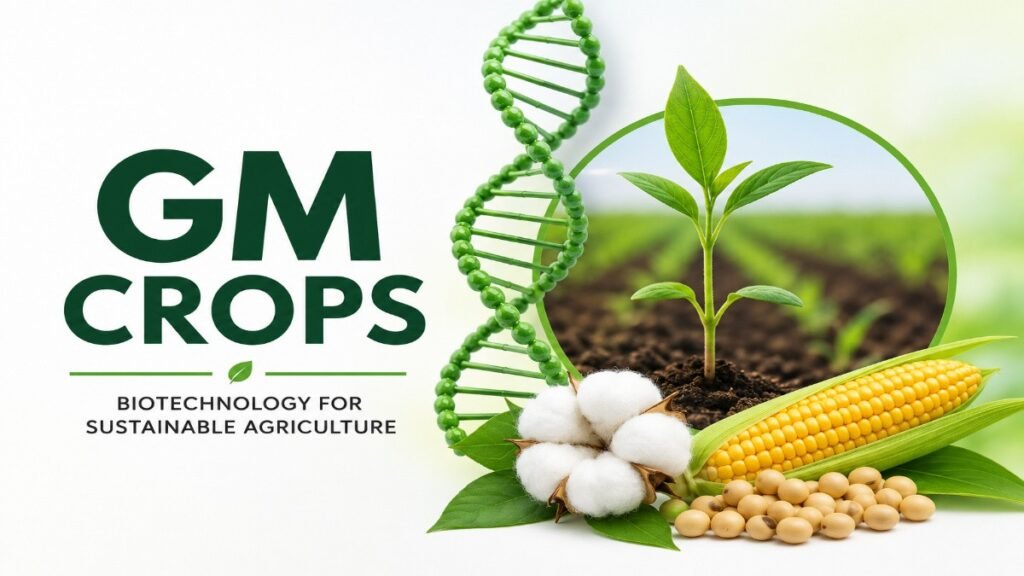
Genetically Modified (GM) Crops are plants whose genetic material (DNA) is deliberately altered using modern biotechnology to introduce desirable traits that are difficult or impossible to achieve through conventional breeding. These traits may include insect resistance, herbicide tolerance, drought tolerance, disease resistance, improved nutritional quality and higher productivity.
GM Crops technology aims to improve agricultural productivity, reduce dependence on chemical pesticides, enhance climate resilience and strengthen food security. Today, the most widely cultivated GM Crops in the world include soybean, maize (corn), cotton and canola. According to the International Service for the Acquisition of Agri-biotech Applications (ISAAA), the United States, Brazil, Argentina, Canada and India are among the leading countries cultivating genetically modified crops.
GM Crops in India have witnessed a cautious and regulated approach. Bt Cotton, approved in 2002, remains the only genetically modified crop permitted for commercial cultivation. While several other Genetically Modified Crops, including GM Mustard, Bt Brinjal, maize, chickpea and rice, are at different stages of research and regulatory evaluation, their commercial adoption continues to be debated due to concerns related to biosafety, biodiversity, human health and farmers’ livelihoods.
The growing importance of Genetically Modified Crops in addressing food security, climate change and sustainable agriculture has made them one of the most debated topics in agricultural biotechnology. These GM Crops Notes provide a comprehensive understanding of the concept, status and significance of GM Crops in India, making the topic highly relevant for BPSC Mains and other competitive examinations.
Master Science & Technology. Maximize Your BPSC Mains Score.
Enroll in the BPSC Science & Tech Course Today
Master Science & Technology for BPSC Mains GS Paper-2 with 75+ exam-oriented topics, 6 structured lessons, and downloadable PDF notes—all in one course.
✔ 75+ Exam-Oriented Topics • ✔ 6 Comprehensive Lessons • ✔ Downloadable PDF Notes • ✔ Updated for 72nd BPSC Mains
2. Status of GM Crops in India
- Bt Cotton is the only Genetically Modified Crops approved for commercial cultivation in India. It was approved by the Genetic Engineering Appraisal Committee (GEAC) in 2002 to protect cotton crops from the American bollworm, resulting in reduced pesticide use and increased cotton production. Today, Bt Cotton remains the most successful example of GM Crops in India.
- Bt Brinjal received approval from GEAC in 2009; however, the Government imposed an indefinite moratorium in 2010 due to concerns over biosafety, biodiversity and public acceptance. Field trials of indigenous Bt Brinjal varieties continue under strict regulatory supervision.
- GM Mustard (DMH-11), developed by the Centre for Genetic Manipulation of Crop Plants (CGMCP), University of Delhi, was recommended by GEAC for environmental release in 2022. However, its commercial cultivation remains sub judice before the Supreme Court, and large-scale cultivation has not yet commenced.
- Several other Genetically Modified Crops, including maize, chickpea, pigeon pea (arhar), rice, potato, tomato and groundnut, are at various stages of laboratory research, confined field trials or biosafety evaluation in India.
3. Regulatory Framework
- India follows a multi-layered regulatory framework for GM Crops under the Environment (Protection) Act, 1986 and the Rules, 1989.
- The Genetic Engineering Appraisal Committee (GEAC) under the Ministry of Environment, Forest and Climate Change (MoEFCC) is the apex body responsible for approving the environmental release and commercial cultivation of genetically modified organisms.
- Research activities related to GM Crops in India are monitored by the Review Committee on Genetic Manipulation (RCGM) under the Department of Biotechnology (DBT).
- India has adopted a precautionary approach towards GM Crops, permitting commercial cultivation only after comprehensive biosafety assessments covering food safety, environmental impact and field performance.
- Although India is among the top five GM crop-growing countries, this position is almost entirely due to the cultivation of Bt Cotton, while the commercial cultivation of food GM Crops remains under regulatory and judicial scrutiny.
The current status of GM Crops in India reflects a balanced approach that seeks to harness the benefits of biotechnology while addressing concerns related to biosafety, environmental protection and public health. These developments form an important part of GM Crops Notes and are highly relevant for BPSC Mains and other competitive examinations.
Prepare Smarter. Study Better. Ace BPSC Mains.
BPSC Mains GS Paper 1 & 2 Complete Course
Access comprehensive BPSC Mains Notes for GS Paper 1 & 2, covering 378+ topics across 24 PDF lessons, with dedicated Bihar coverage, practice questions and downloadable study material.
✓ GS Paper 1 & 2 • ✓ 378+ Topics • ✓ 24 PDF Lessons • ✓ Bihar-Specific Coverage • ✓ Downloadable Notes
4. Advantages and Applications of GM Crops
Higher Agricultural Productivity
Genetically Modified Crops are developed to improve crop productivity by protecting plants from insects, diseases and environmental stresses. This results in higher yields and more stable production. The best example is Bt Cotton in India, which has significantly reduced crop losses due to bollworm infestation and contributed to making India one of the world’s largest producers and exporters of cotton.
Reduced Use of Chemical Pesticides
Insect-resistant Genetically Modified Crops, such as Bt Cotton, produce proteins that are toxic to specific insect pests, thereby reducing the need for repeated pesticide applications. This application of genetic modification lowers cultivation costs, minimises environmental pollution and reduces health risks to farmers exposed to toxic chemicals.
Climate-Resilient Agriculture
Genetically Modified Crops enable the development of crop varieties that can tolerate drought, heat, salinity and water stress, making agriculture more resilient to climate change. Such crops help maintain productivity under adverse climatic conditions and contribute to sustainable agricultural development, highlighting the growing importance of GM Crops in India.
Improved Nutritional Quality (Biofortification)
Genetic modification can enhance the nutritional value of food crops by increasing essential vitamins and minerals. The most well-known example is Golden Rice, which is enriched with beta-carotene (a precursor of Vitamin A) to address Vitamin A deficiency and associated health problems, particularly among children.
Herbicide Tolerance and Better Weed Management
Certain Genetically Modified Crops are engineered to tolerate specific herbicides, enabling effective weed control without damaging the crop. This reduces labour requirements, supports conservation agriculture and facilitates minimum tillage, thereby conserving soil moisture and reducing soil erosion.
Food Security and Farmers’ Income
With rising population, shrinking agricultural land and increasing climate-related risks, GM Crops have the potential to improve food production and farm profitability. Higher yields, reduced input costs and better resistance to biotic and abiotic stresses can enhance farmers’ income while strengthening national food security.
Industrial, Environmental and Medical Applications
The applications of GM Crops extend beyond food production. Genetically modified plants are being explored for the production of edible vaccines, pharmaceutical proteins and next-generation biofuels. GM Crops are also used in phytoremediation, where they help remove heavy metals and other pollutants from contaminated soil and water, contributing to environmental restoration.
The wide-ranging applications of Genetically Modified Crops demonstrate their potential to improve agricultural productivity, nutritional security, climate resilience and environmental sustainability. At the same time, advances in biotechnology are expanding the role of GM Crops in India beyond agriculture into medicine, industry and environmental management. These GM Crops Notes provide a comprehensive understanding of their diverse applications and are highly relevant for BPSC Mains and other competitive examinations.
5. Issues and Concerns Associated with GM Crops
Human Health Concerns
The long-term health impacts of Genetically Modified Crops remain a subject of scientific debate. Concerns include the possibility of allergic reactions, unintended changes in nutritional composition and the transfer of antibiotic resistance markers. Although regulatory authorities approve GM Crops only after rigorous biosafety assessments, many experts advocate continuous long-term monitoring before their widespread adoption.
Environmental Risks
GM Crops may affect biodiversity through gene flow to wild relatives or non-GM crops, potentially creating ecological imbalances. Continuous cultivation of herbicide-tolerant GM Crops can also encourage excessive herbicide use, leading to environmental pollution. For example, the widespread use of glyphosate in herbicide-tolerant crops has resulted in the emergence of glyphosate-resistant weeds in countries such as the United States, Brazil and Argentina.
Development of Pest Resistance and Super Weeds
Continuous exposure of pests to the same Bt toxin can result in the evolution of resistant insect populations, reducing the effectiveness of GM Crops over time. Similarly, repeated use of a single herbicide in herbicide-tolerant crops may lead to the development of ‘super weeds’ that are difficult to control. This necessitates Integrated Pest Management (IPM) and integrated weed management rather than sole reliance on GM technology.
Loss of Biodiversity
The widespread cultivation of a few genetically uniform GM Crops may reduce agricultural biodiversity and increase dependence on limited genetic resources. Gene flow from genetically modified crops to conventional or wild crop varieties could also threaten indigenous germplasm and affect ecological balance, making biodiversity conservation a major concern for GM Crops in India.
Socio-economic Concerns
GM seeds are generally protected by Intellectual Property Rights (IPRs) and patents, making farmers dependent on private seed companies for fresh seeds each season. The higher cost of GM seeds may increase cultivation expenses for small and marginal farmers and raise concerns regarding seed sovereignty and corporate control over agriculture.
Ethical and Regulatory Concerns
The commercialisation of GM Crops involves ethical issues related to food safety, environmental protection, farmers’ rights and consumer choice. In India, the GM Mustard (DMH-11) issue and the moratorium on Bt Brinjal highlight the need for transparent, science-based regulation, public consultation and robust biosafety assessments before commercial approval.
6. Way Forward
- Strengthen science-based regulation: Decisions on GM Crops should be based on rigorous scientific evidence, transparent biosafety assessments and continuous post-release monitoring while ensuring protection of human health and the environment.
- Promote indigenous research and innovation: Greater investment should be made in ICAR, DBT, CSIR and agricultural universities to develop climate-resilient, pest-resistant and nutritionally enhanced GM Crops suited to Indian agro-climatic conditions.
- Ensure robust regulatory oversight: The capacity of regulatory bodies such as the GEAC and RCGM should be strengthened to ensure timely, transparent and credible evaluation of GM Crops in India.
- Protect farmers’ interests: Policies should ensure affordable access to quality seeds, prevent monopolistic practices, safeguard farmers’ seed rights and promote public-sector GM technologies.
- Adopt an integrated approach: GM Crops should complement conventional breeding, biotechnology, precision agriculture, Integrated Pest Management (IPM) and sustainable farming practices rather than replace them.
7. Conclusion
Genetically Modified Crops have the potential to significantly improve agricultural productivity, food security, nutritional quality and climate resilience. Their ability to reduce pesticide use, enhance crop yields and develop stress-tolerant varieties makes them an important technological intervention for sustainable agriculture.
However, the future of GM Crops in India depends on balancing scientific innovation with concerns relating to biosafety, biodiversity, human health and farmers’ welfare. A transparent, science-based and robust regulatory framework, coupled with indigenous research and public engagement, will be essential for harnessing the benefits of biotechnology while ensuring environmental sustainability and public confidence. These GM Crops Notes provide a comprehensive understanding of the opportunities and challenges associated with genetically modified crops, making the topic highly relevant for BPSC Mains and other competitive examinations.
Learn More from the Genetic Engineering Appraisal Committee (GEAC):
Readers interested in GM Crops, the regulatory framework for GM Crops in India, biosafety guidelines, environmental approvals and decisions related to genetically modified organisms can visit the official website of the Genetic Engineering Appraisal Committee (GEAC), Ministry of Environment, Forest and Climate Change (MoEFCC). The portal provides authentic information on approvals, regulatory guidelines, meeting minutes and policies related to GM Crops.
Official Website:
BPSC Mains Practice Questions
Q1. “GM Crops offer significant opportunities for enhancing agricultural productivity, but they also raise important biosafety and socio-economic concerns.” Critically examine the advantages and challenges associated with GM Crops in India.
Q2. Discuss the regulatory framework governing GM Crops in India. Evaluate the current status of GM Crops in India, with special reference to Bt Cotton, Bt Brinjal and GM Mustard (DMH-11).