1. Introduction and Concept of Internet of Things (IoT)
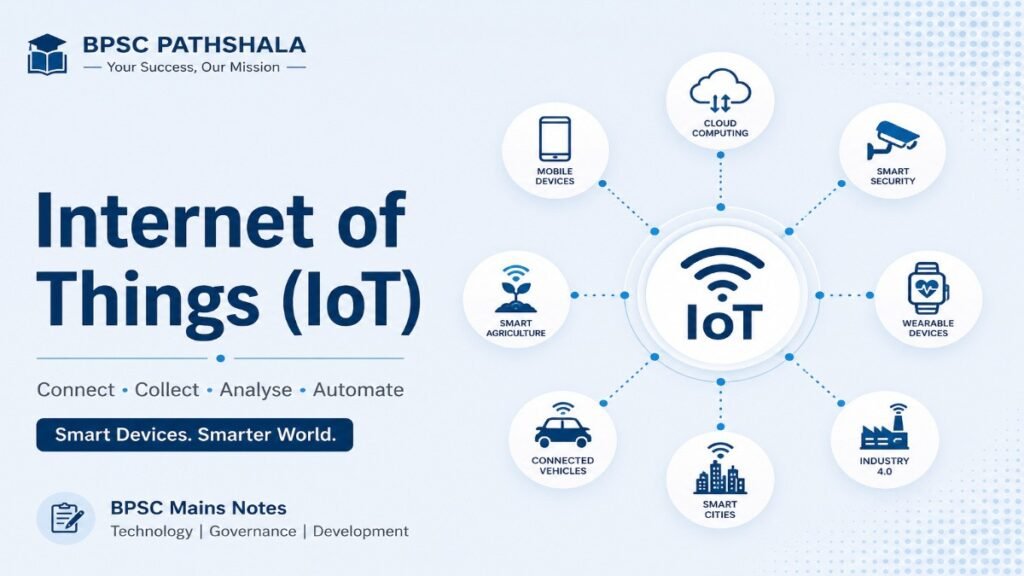
The Internet of Things (IoT) refers to a network of physical objects or “things” embedded with sensors, software, processors and communication technologies that enable them to collect, exchange and process data over the internet without requiring continuous human intervention. These “things” include smartphones, smart home appliances, wearable devices, vehicles, industrial machines, agricultural equipment and public infrastructure. By connecting the physical and digital worlds, the Internet of Things (IoT) enables devices to communicate with each other, monitor their surroundings and perform tasks automatically, making systems more intelligent and efficient.
The Internet of Things (IoT) operates through a combination of sensors, internet connectivity, cloud computing and Artificial Intelligence (AI). Sensors collect real-time data, which is transmitted through communication networks such as Wi-Fi, Bluetooth, 5G or Low Power Wide Area Networks (LPWAN). The collected data is then analysed using cloud platforms and AI algorithms to generate insights or trigger automated actions. For example, a smart irrigation system can automatically supply water to crops based on real-time soil moisture levels, while a fitness band continuously monitors heart rate and physical activity.
The rapid expansion of the Internet of Things (IoT) has been driven by advancements in 5G technology, cloud computing, Artificial Intelligence (AI), Big Data Analytics and Edge Computing. These technologies have made it possible to connect billions of devices and process massive amounts of data efficiently. As a result, the Internet of Things (IoT) has emerged as a key driver of the Fourth Industrial Revolution (Industry 4.0) and the digital economy.
Today, the Internet of Things (IoT) is transforming sectors such as agriculture, healthcare, manufacturing, transport, urban governance and public service delivery by improving efficiency, reducing costs, enabling real-time decision-making and enhancing the quality of life. Consequently, it is regarded as one of the most important emerging technologies for achieving the goals of Digital India, Smart Cities Mission and Viksit Bharat 2047. These Internet of Things (IoT) Notes provide a comprehensive understanding of the concept, working and significance of IoT, making the topic highly relevant for Internet of Things BPSC preparation, BPSC Mains and other competitive examinations.
Master Science & Technology. Maximize Your BPSC Mains Score.
Enroll in the BPSC Science & Tech Course Today
Master Science & Technology for BPSC Mains GS Paper-2 with 75+ exam-oriented topics, 6 structured lessons, and downloadable PDF notes—all in one course.
✔ 75+ Exam-Oriented Topics • ✔ 6 Comprehensive Lessons • ✔ Downloadable PDF Notes • ✔ Updated for 72nd BPSC Mains
2. Applications of Internet of Things (IoT)
Smart Homes and Daily Life
The Internet of Things (IoT) has transformed everyday life by enabling smart homes, where connected devices communicate with each other and can be monitored or controlled remotely through smartphones or voice assistants. Smart appliances such as lighting systems, air conditioners, refrigerators, security cameras, door locks and energy meters automatically adjust their functioning based on user preferences, thereby improving convenience, energy efficiency and security.
For example, a smart thermostat can reduce electricity consumption by automatically regulating room temperature, while smart security cameras can send real-time alerts to homeowners during emergencies. According to industry estimates, billions of IoT devices are already in use worldwide, making smart homes one of the fastest-growing applications of the Internet of Things (IoT).
Agriculture and Precision Farming
The Internet of Things (IoT) is revolutionising agriculture through precision farming, where decisions are based on real-time data rather than traditional practices. Sensors installed in fields continuously monitor soil moisture, nutrient levels, temperature, humidity and weather conditions, enabling farmers to optimise irrigation, fertiliser use and pest control. IoT-enabled drones can monitor crop health, estimate yields and spray pesticides with greater accuracy, reducing input costs and increasing productivity.
In India, these technologies complement initiatives such as the Digital Agriculture Mission (2021–2025) and the use of drones under the Sub-Mission on Agricultural Mechanization (SMAM). By improving resource efficiency and reducing wastage, the Internet of Things (IoT) supports sustainable agriculture and helps increase farmers’ incomes.
Healthcare
The Internet of Things (IoT) is improving healthcare by enabling continuous remote monitoring of patients through wearable devices such as smartwatches, fitness bands, glucose monitors and heart-rate sensors. These devices transmit real-time health data to doctors, allowing early diagnosis and timely medical intervention. IoT also supports telemedicine, connected ambulances and AI-assisted disease diagnosis, particularly benefiting patients in rural and remote areas.
In India, the Ayushman Bharat Digital Mission (ABDM) aims to integrate digital health records and healthcare services, while IoT-enabled devices strengthen remote healthcare delivery. During the COVID-19 pandemic, wearable health devices and remote monitoring systems played an important role in tracking patient health and reducing hospital burden.
Industry and Manufacturing (Industry 4.0)
The Internet of Things (IoT) is a key pillar of Industry 4.0, enabling the development of smart factories where machines, robots and sensors communicate in real time. Industries use IoT for predictive maintenance, automated quality control, inventory management, energy monitoring and supply chain optimisation, thereby reducing downtime and production costs.
Smart sensors can detect equipment faults before failure, preventing costly breakdowns and improving operational efficiency. In India, IoT adoption supports national initiatives such as Make in India, Atmanirbhar Bharat and the Production Linked Incentive (PLI) Scheme, helping industries improve productivity and global competitiveness.
Smart Cities and Urban Governance
The Internet of Things (IoT) plays a vital role in the development of Smart Cities by improving the efficiency of urban services through connected infrastructure. Smart sensors are used for intelligent traffic management, smart street lighting, waste collection, water supply monitoring, pollution monitoring and energy management. These systems reduce operational costs while improving service delivery and environmental sustainability.
Under India’s Smart Cities Mission, several cities have established Integrated Command and Control Centres (ICCCs) that use IoT devices, CCTV cameras and data analytics for real-time urban governance, emergency response and public safety. Such applications contribute to more efficient, sustainable and citizen-centric urban management.
Transport and Logistics
The Internet of Things (IoT) has transformed the transport sector by enabling Intelligent Transportation Systems (ITS) and real-time fleet management. GPS-enabled sensors help track the location, speed, fuel consumption and condition of vehicles, improving logistics efficiency and reducing operational costs. Smart traffic signals, FASTag and connected public transport improve traffic flow and reduce congestion.
Logistics companies use IoT to monitor the movement of goods, maintain cold-chain integrity for medicines and food products and optimise delivery routes. These applications enhance road safety, reduce fuel consumption and improve supply chain efficiency.
Governance and Public Service Delivery
Governments are increasingly using the Internet of Things (IoT) to improve public administration and citizen services. Smart water meters, electricity meters, waste management systems, environmental monitoring stations and disaster warning systems enable authorities to monitor public infrastructure in real time and respond quickly to emergencies.
IoT also strengthens e-governance by improving service delivery, reducing resource wastage and increasing transparency. For instance, smart sensors can detect water leakages in urban pipelines or monitor air quality to support pollution control measures. With the expansion of 5G networks and the Digital India Mission, the Internet of Things (IoT) is expected to become a critical tool for delivering efficient, data-driven and citizen-centric governance.
The diverse applications of the Internet of Things (IoT) demonstrate its transformative impact across agriculture, healthcare, manufacturing, urban governance and public administration. As IoT adoption continues to expand, these technologies are driving innovation, improving productivity and supporting India’s digital transformation. These Internet of Things (IoT) Notes provide a comprehensive understanding of real-world IoT applications and are highly relevant for Internet of Things BPSC preparation, BPSC Mains and other competitive examinations.
Prepare Smarter. Study Better. Ace BPSC Mains.
BPSC Mains GS Paper 1 & 2 Complete Course
Access comprehensive BPSC Mains Notes for GS Paper 1 & 2, covering 378+ topics across 24 PDF lessons, with dedicated Bihar coverage, practice questions and downloadable study material.
✓ GS Paper 1 & 2 • ✓ 378+ Topics • ✓ 24 PDF Lessons • ✓ Bihar-Specific Coverage • ✓ Downloadable Notes
3. Status of Internet of Things (IoT) in India
- The Government of India has identified the Internet of Things (IoT) as a key technology for achieving the objectives of Digital India, Smart Cities and a digitally empowered economy.
- The National Digital Communications Policy (NDCP), 2018 promotes the adoption of the Internet of Things (IoT), 5G, Machine-to-Machine (M2M) communication, Artificial Intelligence (AI), cloud computing and Big Data Analytics to accelerate India’s digital transformation.
- The Department of Telecommunications (DoT) has issued guidelines for Machine-to-Machine (M2M) communications, creating an enabling regulatory framework for the deployment of the Internet of Things (IoT).
- The Smart Cities Mission is leveraging the Internet of Things (IoT) for intelligent traffic management, smart street lighting, smart parking, waste management, water supply monitoring, pollution monitoring and Integrated Command and Control Centres (ICCCs).
- The Digital Agriculture Mission (2021–2025) promotes IoT-enabled precision farming through smart sensors, drones, weather-based advisory systems and automated irrigation, making the Internet of Things (IoT) a key technology for modern agriculture.
- Under the Ayushman Bharat Digital Mission (ABDM), IoT-enabled wearable devices, remote patient monitoring and digital health records are strengthening digital healthcare delivery across the country.
- The nationwide rollout of 5G services since October 2022 is expected to accelerate the adoption of the Internet of Things (IoT) by providing high-speed, low-latency and reliable connectivity for billions of connected devices.
- The expansion of broadband connectivity through the BharatNet Project is improving internet access in rural India, enabling wider adoption of IoT-based services in agriculture, education, healthcare and governance.
- Government initiatives such as Make in India, Atmanirbhar Bharat and the Production Linked Incentive (PLI) Scheme are promoting domestic manufacturing of electronics, sensors, semiconductor components and IoT devices, strengthening the ecosystem for the Internet of Things (IoT).
- India has emerged as one of the world’s fastest-growing startup ecosystems, with numerous start-ups developing innovative Internet of Things (IoT) solutions for agriculture, healthcare, logistics, manufacturing and smart city applications.
- According to NASSCOM, India’s IoT market is expected to witness rapid growth in the coming years, driven by increasing digitalisation, industrial automation, expansion of 5G networks and rising adoption of Industry 4.0 technologies.
The rapid growth of the Internet of Things (IoT) in India is being driven by supportive government policies, expanding digital infrastructure, widespread 5G deployment and a vibrant innovation ecosystem. These developments position IoT as a critical technology for achieving the goals of Digital India, Smart Cities, Atmanirbhar Bharat and Viksit Bharat 2047. These Internet of Things (IoT) Notes are highly relevant for Internet of Things BPSC preparation, BPSC Mains and other competitive examinations.
4. Challenges of Internet of Things (IoT)
- Cybersecurity Threats: The rapid expansion of the Internet of Things (IoT) has resulted in billions of interconnected devices, increasing the risk of hacking, malware, ransomware, botnet attacks and cyberattacks. Weakly secured IoT devices can become entry points for attackers, posing serious threats to critical infrastructure and national security.
- Data Privacy Concerns: The Internet of Things (IoT) continuously collects large volumes of personal and sensitive data, raising concerns regarding data misuse, surveillance, identity theft and unauthorised access. Ensuring robust data protection and privacy safeguards is essential for building public trust in IoT technologies.
- High Infrastructure Cost: Large-scale deployment of the Internet of Things (IoT) requires reliable internet connectivity, sensors, cloud infrastructure, edge computing facilities and 5G networks, involving substantial investment. This poses challenges, particularly for developing countries and resource-constrained sectors.
- Lack of Standardisation: Different manufacturers often use different communication protocols and technical standards, leading to interoperability issues among IoT devices. The absence of universally accepted standards reduces compatibility, scalability and seamless integration of IoT ecosystems.
- Digital Divide: Limited internet connectivity, inadequate digital infrastructure and low digital literacy in rural and remote areas hinder the widespread adoption of the Internet of Things (IoT). Bridging this divide is crucial to ensure inclusive digital development across India.
- Job Displacement: Increased automation driven by the Internet of Things (IoT) may reduce demand for low-skilled jobs in manufacturing, logistics and service sectors. This necessitates large-scale reskilling and upskilling of the workforce to meet the requirements of the digital economy.
5. Way Forward and Conclusion
To fully realise the potential of the Internet of Things (IoT), India must strengthen its cybersecurity framework and implement robust data protection measures to safeguard users’ privacy and secure critical digital infrastructure. Expanding 5G networks and optical fibre connectivity is essential for enabling seamless communication among billions of connected devices.
The Government should continue to promote indigenous IoT manufacturing under initiatives such as Make in India and Atmanirbhar Bharat to reduce import dependence and strengthen technological self-reliance. Developing common technical standards will ensure interoperability among devices manufactured by different companies, thereby improving efficiency and user experience.
At the same time, greater investment in digital literacy, research, innovation and skill development is necessary to create a workforce capable of supporting Industry 4.0 and the digital economy. With sustained policy support, secure digital infrastructure and continuous innovation, the Internet of Things (IoT) can become a powerful driver of Digital India, smart governance, sustainable development and the vision of Viksit Bharat 2047.
The Internet of Things (IoT) is transforming the way people, devices and systems interact by enabling real-time data exchange, automation and intelligent decision-making. As the adoption of IoT continues to expand across agriculture, healthcare, manufacturing, transport and governance, it will play a pivotal role in accelerating India’s digital transformation. These Internet of Things (IoT) Notes provide a comprehensive understanding of the concept, applications, challenges and future prospects of IoT, making them highly useful for Internet of Things BPSC preparation, BPSC Mains and other competitive examinations.
Learn More from the Department of Telecommunications (DoT):
Readers interested in the Internet of Things (IoT), Machine-to-Machine (M2M) communication, IoT standards, smart city applications and government initiatives can visit the official Internet of Things (IoT) Division of the Telecommunication Engineering Centre (TEC), Department of Telecommunications, Government of India. The portal provides authentic information on IoT standards, technical reports, security guidelines and policy initiatives related to the Internet of Things (IoT).
BPSC Mains Practice Questions
Q1. “The Internet of Things (IoT) is a key enabler of the Fourth Industrial Revolution.” Discuss the major applications of the Internet of Things (IoT) in agriculture, healthcare, manufacturing and smart governance.
Q2. Examine the current status of the Internet of Things (IoT) in India. Discuss the major challenges associated with IoT adoption and suggest suitable measures to promote its secure and inclusive growth.