1. Net Zero: Meaning and India’s Commitment
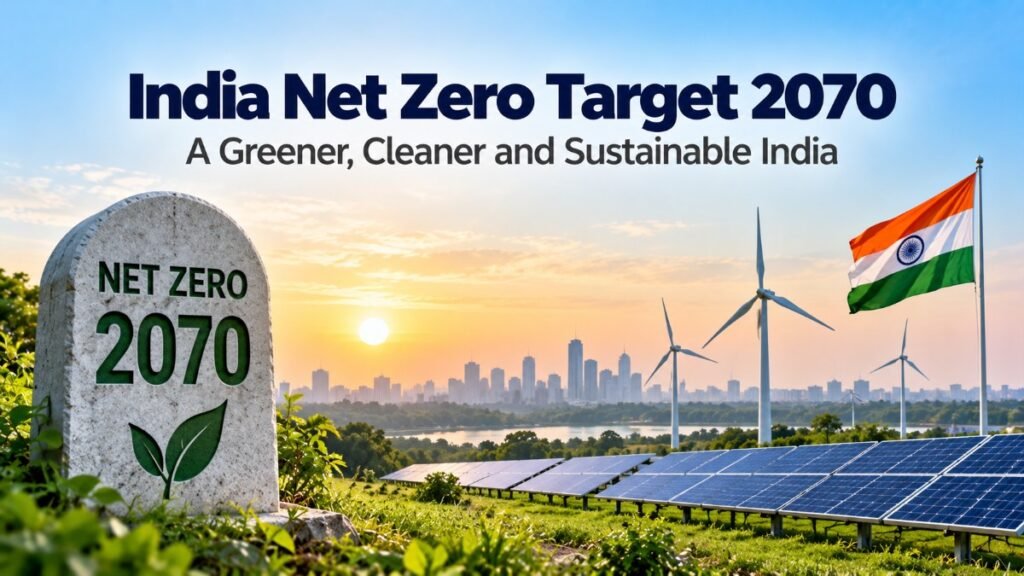
India Net Zero Target 2070 refers to India’s long-term commitment to achieve a state where the total greenhouse gas (GHG) emissions released into the atmosphere are balanced by an equal amount of emissions removed or absorbed through natural carbon sinks such as forests or technologies like carbon capture and storage. It does not mean eliminating all emissions; rather, it aims to ensure that net emissions become zero.
Unlike Zero Emissions, which requires complete elimination of greenhouse gas emissions, Net Zero India allows limited unavoidable emissions, provided they are offset by carbon removal measures. Net Zero has emerged as a key global strategy to limit the rise in global temperature to 1.5°C above pre-industrial levels, as envisaged under the Paris Agreement (2015).
Why is Net Zero Required?
- To mitigate climate change and reduce the frequency of extreme weather events such as heatwaves, floods, droughts, and cyclones.
- To achieve the objectives of the Paris Agreement and prevent irreversible damage to ecosystems.
- To promote sustainable economic growth through clean energy, green technologies, and low-carbon development.
- To ensure energy security by reducing dependence on fossil fuels.
India’s Commitment to Net Zero
- At the 26th Conference of Parties (COP26) held in Glasgow (2021), Prime Minister Narendra Modi announced that India will achieve Net Zero emissions by 2070 as part of its climate action strategy.
- India also presented the ‘Panchamrit’ (Five Nectar Elements), outlining measurable climate targets for 2030 and the long-term goal of Net Zero by 2070. These commitments have since been reflected in India’s updated climate commitments and long-term strategy.
Why did India choose the Year 2070?
- India is the world’s third-largest emitter of greenhouse gases in absolute terms, but its per capita emissions remain much lower than those of most developed countries.
- India has emphasized the principle of Climate Justice and Common but Differentiated Responsibilities and Respective Capabilities (CBDR-RC), arguing that developed countries bear a greater historical responsibility for global emissions.
- As a developing economy with growing energy and infrastructure needs, India requires additional time to ensure that economic growth, poverty eradication, and energy access are achieved alongside decarbonization.
- India has also highlighted that achieving India Net Zero Target 2070 will require adequate climate finance, affordable green technologies, and international cooperation, particularly from developed nations.
India is among the few major economies to have submitted both an Updated Nationally Determined Contribution (NDC) and a Long-Term Low Emission Development Strategy (LT-LEDS) to the UNFCCC, providing a roadmap for achieving Net Zero Emissions in India by 2070.
Master Science & Technology. Maximize Your BPSC Mains Score.
Enroll in the BPSC Science & Tech Course Today
Master Science & Technology for BPSC Mains GS Paper-2 with 75+ exam-oriented topics, 6 structured lessons, and downloadable PDF notes—all in one course.
✔ 75+ Exam-Oriented Topics • ✔ 6 Comprehensive Lessons • ✔ Downloadable PDF Notes • ✔ Updated for 72nd BPSC Mains
2. India’s Climate Commitments: Panchamrit and Updated NDC Targets
At the COP26 Climate Summit (Glasgow, 2021), India announced the Panchamrit (Five Nectar Elements) as its roadmap towards low-carbon development and India Net Zero 2070. These commitments were subsequently incorporated into India’s Updated Nationally Determined Contributions (NDCs) approved by the Union Cabinet in August 2022 and communicated to the UNFCCC.
Panchamrit (Five Nectar Elements)
(i) Achieve 500 GW of Non-Fossil Fuel-based Installed Electricity Capacity by 2030
- India aims to install 500 GW of electricity generation capacity from non-fossil sources such as solar, wind, hydro, and nuclear energy by 2030.
- This will significantly reduce dependence on coal and accelerate the clean energy transition.
- Progress: India has already achieved over 50% of its installed electricity capacity from non-fossil fuel sources, reaching this milestone ahead of the original 2030 timeline.
(ii) Meet 50% of Installed Electricity Capacity from Non-Fossil Fuel Sources by 2030
- India has committed that about 50% of its cumulative installed electricity capacity will come from non-fossil fuel-based energy resources by 2030.
- This target was formally included in India’s Updated NDC (2022) under the Paris Agreement.
(iii) Reduce Cumulative Carbon Emissions by One Billion Tonnes by 2030
- India has pledged to reduce its projected cumulative carbon emissions by one billion tonnes between 2021 and 2030.
- This will be achieved through greater use of renewable energy, improved energy efficiency, clean transport, and sustainable industrial practices.
- It represents one of the largest emission reduction commitments made by any developing country.
(iv) Reduce the Emissions Intensity of GDP by 45% by 2030
- India has committed to reducing the emissions intensity of its GDP by 45% below 2005 levels by 2030.
- Emissions intensity means the amount of greenhouse gas emitted per unit of economic output (GDP).
- Progress: India’s emission intensity had already declined by 33% (2005–2019) and continues to decrease through renewable energy expansion, energy efficiency, and cleaner technologies.
(v) Achieve Net Zero Emissions by 2070
- India has pledged to achieve Net Zero greenhouse gas emissions by 2070, balancing emissions with carbon removal through forests and technological solutions.
- The target recognizes India’s developmental priorities while aligning with global climate goals.
- To support this objective, India submitted its Long-Term Low Emission Development Strategy (LT-LEDS) to the UNFCCC in 2022, outlining pathways for low-carbon growth across sectors such as energy, transport, industry, urban development, and forests.
Updated Nationally Determined Contributions (NDCs), 2022
The Union Cabinet approved India’s updated Nationally Determined Contributions (NDCs) in August 2022, translating the Panchamrit announcements into formal international commitments under the Paris Agreement. The updated NDC commits India to:
- Reduce emissions intensity of GDP by 45% from 2005 levels by 2030.
- Achieve about 50% cumulative installed electric power capacity from non-fossil fuel sources by 2030.
- Promote Lifestyle for Environment (LiFE) as a mass movement for sustainable living.
- Support the long-term goal of achieving Net Zero Emissions in India by 2070.
India has already overachieved its original Paris Agreement targets by attaining 43.8% non-fossil installed power capacity (2023) and reducing emission intensity by 33% (2019) well ahead of schedule, demonstrating its strong commitment to India Climate Action.
Prepare Smarter. Study Better. Ace BPSC Mains.
BPSC Mains GS Paper 1 & 2 Complete Course
Access comprehensive BPSC Mains Notes for GS Paper 1 & 2, covering 378+ topics across 24 PDF lessons, with dedicated Bihar coverage, practice questions and downloadable study material.
✓ GS Paper 1 & 2 • ✓ 378+ Topics • ✓ 24 PDF Lessons • ✓ Bihar-Specific Coverage • ✓ Downloadable Notes
3. Why is Net Zero Important for India?
Environmental Significance
- Helps limit global warming and supports the goal of keeping temperature rise within 1.5°C under the Paris Agreement.
- Reduces greenhouse gas emissions, thereby mitigating the frequency and intensity of heatwaves, floods, droughts, and cyclones.
- Conserves biodiversity, forests, glaciers, and other critical ecosystems by reducing climate-related stress.
- Supports restoration of natural carbon sinks through afforestation and ecosystem conservation.
Economic Significance
- Promotes green growth by encouraging investment in renewable energy, green hydrogen, electric mobility, and clean technologies.
- Creates green jobs in sectors such as solar energy, wind energy, battery manufacturing, and sustainable infrastructure.
- Enhances India’s global competitiveness by aligning exports with emerging low-carbon standards and carbon border regulations.
- Reduces long-term economic losses arising from climate-induced disasters and environmental degradation.
Energy Security
- Reduces dependence on imported coal, crude oil, and natural gas, thereby improving energy security.
- Encourages greater use of indigenous renewable resources such as solar, wind, hydro, biomass, and green hydrogen.
- Diversifies the energy mix, making India’s energy system more resilient and sustainable.
Public Health and Sustainable Development
- Lower fossil fuel consumption improves air quality, reducing respiratory and cardiovascular diseases.
- Supports the achievement of SDG 3 (Good Health), SDG 7 (Affordable and Clean Energy), SDG 11 (Sustainable Cities), and SDG 13 (Climate Action).
- Contributes to sustainable urbanization through clean transport, energy-efficient buildings, and better waste management.
- Improves the quality of life while ensuring environmentally sustainable development.
India’s Global Climate Leadership
- Reinforces India’s commitment to Climate Justice and the principle of Common but Differentiated Responsibilities and Respective Capabilities (CBDR-RC).
- Strengthens India’s leadership through initiatives such as the International Solar Alliance (ISA), Coalition for Disaster Resilient Infrastructure (CDRI), and the Global Biofuels Alliance.
- Enhances India’s credibility as a responsible partner in global climate governance while safeguarding the developmental interests of developing countries.
The India Net Zero Target 2070 therefore has significance beyond emission reduction. It connects India Climate Goals with energy security, economic growth, public health, sustainable development, and India’s role in global climate governance.
4. Government Initiatives Towards Achieving Net Zero
National Green Hydrogen Mission (2023)
- Approved by the Union Cabinet with an outlay of ₹19,744 crore to make India a global hub for the production, use, and export of green hydrogen.
- Targets 5 Million Metric Tonnes (MMT) of green hydrogen production annually by 2030, supported by around 125 GW of additional renewable energy capacity.
- Expected to attract over ₹8 lakh crore of investments, create more than 6 lakh jobs, reduce fossil fuel imports by over ₹1 lakh crore, and avoid nearly 50 MMT of greenhouse gas emissions annually by 2030.
- Focuses on decarbonizing hard-to-abate sectors such as steel, cement, fertilizers, refineries, shipping, and heavy transport.
Renewable Energy Expansion and PM Surya Ghar: Muft Bijli Yojana
- India is rapidly expanding solar, wind, hydro, and nuclear power to achieve the Panchamrit target of 500 GW non-fossil electricity capacity by 2030.
- The PM Surya Ghar: Muft Bijli Yojana (2024) aims to install rooftop solar systems in 1 crore households with a financial outlay of ₹75,021 crore.
- According to the Ministry of New and Renewable Energy, the scheme is expected to generate 1,000 billion units of clean electricity over the lifetime of the installations and reduce 720 million tonnes of CO₂ equivalent emissions, while creating around 17 lakh jobs.
- These initiatives reduce dependence on fossil fuels and accelerate the transition to clean electricity.
Carbon Market and Green Credit Programme
- India has introduced the Carbon Credit Trading Scheme (CCTS), 2023 to create a domestic carbon market that incentivizes industries to reduce greenhouse gas emissions.
- The Green Credit Programme, launched under the Environment (Protection) Act, 1986, promotes voluntary environmental actions such as afforestation, water conservation, and sustainable resource management.
- These market-based mechanisms encourage industries to adopt cleaner technologies while supporting India’s long-term decarbonization pathway.
Mission LiFE (Lifestyle for Environment)
- Launched by the Prime Minister in 2022, Mission LiFE promotes sustainable lifestyles by encouraging behavioural changes among citizens.
- It advocates the concept of “Pro-Planet People (P3)”, emphasizing responsible consumption, energy conservation, waste reduction, water conservation, and sustainable mobility.
- Since household consumption contributes significantly to carbon emissions, Mission LiFE complements technological solutions by promoting low-carbon lifestyles, making climate action a people’s movement.
Energy Efficiency and Clean Mobility
- The Perform, Achieve and Trade (PAT) Scheme under the National Mission for Enhanced Energy Efficiency (NMEEE) promotes energy efficiency in energy-intensive industries such as steel, cement, aluminium, fertilizers, and thermal power.
- India is also promoting electric mobility through the PM E-Drive Scheme, expansion of EV charging infrastructure, and increased use of biofuels and ethanol blending to reduce transport-sector emissions.
- These initiatives lower energy consumption, reduce fossil fuel dependence, and contribute significantly towards achieving the India Net Zero Target 2070.
5. India’s Progress Towards Net Zero
- Rapid Growth in Renewable Energy: According to the Ministry of New and Renewable Energy (MNRE), India has emerged as the 4th largest installed renewable energy capacity in the world. As of June 2025, India’s total installed renewable energy capacity exceeded 235 GW, with solar energy contributing the largest share.
- Early Achievement of Non-Fossil Capacity Target: According to the Central Electricity Authority (CEA), more than 50% of India’s installed electricity capacity now comes from non-fossil fuel sources, achieving one of the Panchamrit commitments well ahead of the 2030 target.
- Reduction in Emissions Intensity: India has reduced the emissions intensity of its GDP by 36% between 2005 and 2020, moving steadily towards the target of 45% reduction by 2030, as reported in the Government’s Biennial Update Reports and official climate submissions.
- Expansion of Clean Mobility and Biofuels: India has witnessed rapid growth in electric vehicles (EVs), expansion of charging infrastructure, and increased adoption of 20% ethanol blending (E20) in petrol under the National Biofuel Policy, reducing dependence on fossil fuels.
- Increasing Carbon Sink: Through afforestation and tree plantation programmes such as the Green India Mission and Compensatory Afforestation Fund (CAMPA), India continues to enhance its forest and tree cover, contributing to carbon sequestration. According to the India State of Forest Report (ISFR) 2023, the country’s forest and tree cover stands at 25.17% of the geographical area.
- Global Recognition: India is among the few G20 countries that are broadly on track to achieve their Nationally Determined Contributions (NDCs). Its balanced approach of economic development with climate action has strengthened its position as a leader among developing nations in global climate negotiations.
India Climate Action is also reflected in its broader development approach. India contributes nearly 17% of the world’s population but accounts for only about 4% of cumulative global CO₂ emissions, reinforcing its position that climate action should be guided by the principle of Climate Justice and Common but Differentiated Responsibilities (CBDR-RC).
6. Challenges in Achieving Net Zero
- High Dependence on Coal: Coal continues to account for nearly 70% of India’s electricity generation, making the transition to a low-carbon economy challenging while ensuring affordable and reliable energy.
- Huge Climate Finance Requirement: According to NITI Aayog, India may require over USD 10 trillion between 2020 and 2070 to achieve its Net Zero target. Mobilizing adequate domestic and international climate finance remains a major challenge.
- Technology and Infrastructure Gaps: Large-scale deployment of green hydrogen, battery energy storage systems (BESS), carbon capture, utilization and storage (CCUS), and smart grids requires advanced technologies, skilled manpower, and substantial investments.
- Decarbonization of Hard-to-Abate Sectors: Industries such as steel, cement, fertilizers, aviation, and shipping are highly dependent on fossil fuels and currently have limited commercially viable low-carbon alternatives.
- Balancing Development with Climate Goals: As one of the fastest-growing major economies, India must simultaneously ensure energy access, industrialization, employment generation, and poverty alleviation, making the transition more complex than in developed countries.
- Just Transition: Millions of people are directly or indirectly dependent on the coal mining and thermal power sectors. A successful Net Zero pathway requires reskilling workers, creating alternative livelihoods, and ensuring that the energy transition is socially inclusive.
These challenges make Net Zero Emissions in India a complex long-term transition requiring finance, technology, infrastructure, and social inclusion. Addressing them is essential for achieving the India Net Zero Target 2070 without compromising India’s developmental priorities.
7. Way Forward
- Accelerate Renewable Energy Deployment: Fast-track the achievement of the 500 GW non-fossil fuel capacity target by 2030 through greater investment in solar, wind, hydro, and offshore wind energy.
- Scale Up Green Hydrogen and Energy Storage: Promote large-scale production of green hydrogen, battery energy storage systems (BESS), and pumped hydro storage to decarbonize hard-to-abate sectors and ensure grid stability.
- Strengthen Carbon Markets and Green Finance: Operationalize the Carbon Credit Trading Scheme (CCTS), encourage green bonds, and mobilize international climate finance and technology transfer.
- Promote Sustainable Mobility and Energy Efficiency: Expand electric mobility, public transport, biofuels, and energy-efficient industries through schemes such as PM E-Drive and the PAT Scheme.
- Enhance Carbon Sinks: Increase forest and tree cover through afforestation, agroforestry, mangrove restoration, and ecosystem conservation to improve carbon sequestration.
- Encourage Lifestyle and Behavioural Change: Strengthen Mission LiFE by promoting responsible consumption, resource efficiency, waste reduction, and sustainable lifestyles among citizens.
- Ensure a Just and Inclusive Transition: Protect the interests of workers and communities dependent on fossil fuel industries through reskilling, social protection, and creation of green employment opportunities.
Effective India Climate Goals require a coordinated approach combining clean energy, carbon sinks, sustainable mobility, energy efficiency, and behavioural change. Strong India Climate Action at both national and state levels will be essential for achieving Net Zero Emissions in India while ensuring inclusive economic development.
The India Net Zero Target 2070 should therefore be pursued through a predictable policy framework, technological innovation, adequate climate finance, and international cooperation.
8. Conclusion
India’s India Net Zero Target 2070 commitment reflects a balanced approach that integrates economic development, energy security, and environmental sustainability. Through the Panchamrit targets, rapid expansion of renewable energy, green hydrogen, clean mobility, and sustainable lifestyles, India has laid a strong foundation for a low-carbon future.
However, achieving Net Zero India will require sustained policy support, technological innovation, climate finance, and international cooperation based on the principles of Climate Justice and Common but Differentiated Responsibilities (CBDR-RC).
Successfully meeting the India Net Zero 2070 target will not only help combat climate change but also contribute significantly to the vision of Viksit Bharat 2047 and the achievement of the Sustainable Development Goals (SDGs).
BPSC Mains Practice Questions
- Discuss India’s Net Zero Target 2070 in the context of climate change, energy security, economic development, and the principle of climate justice.
- What are the major challenges in achieving Net Zero Emissions in India by 2070? Suggest a suitable roadmap for a just and inclusive energy transition.
Learn More About India’s Net Zero Target
For official information on India’s climate goals, Nationally Determined Contributions (NDCs), Long-Term Low Emission Development Strategy (LT-LEDS), and climate action, visit the Ministry of Environment, Forest and Climate Change (MoEFCC) Official Website.