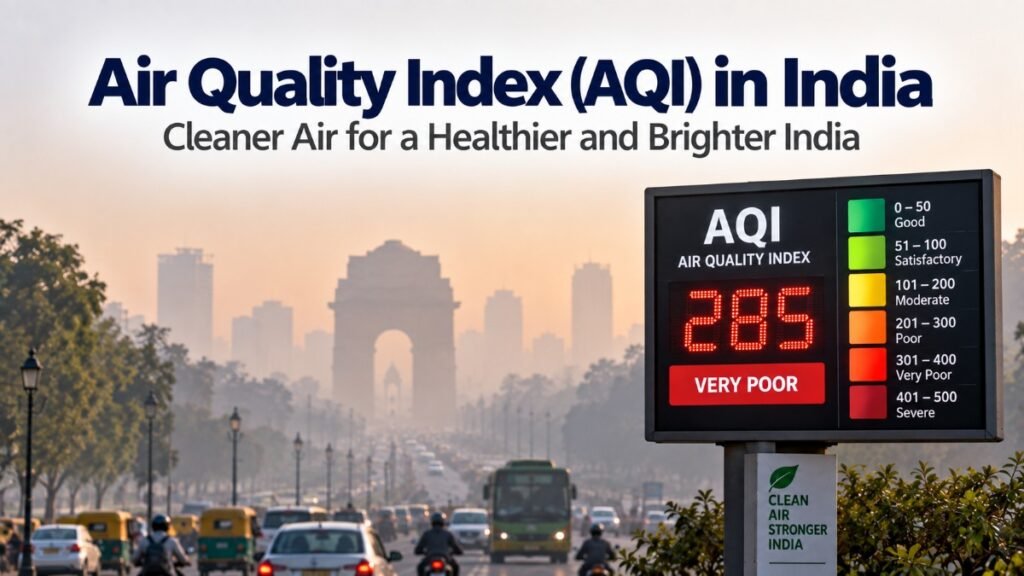
1. Air Quality Index (AQI): Meaning and Significance
The Air Quality Index (AQI) in India is a scientific tool used to measure and communicate the quality of ambient air and its likely impact on human health. It converts complex data on multiple air pollutants into a single numerical value and colour code, enabling the public to easily understand the level of air pollution and take necessary precautions. In India, the National Air Quality Index (NAQI) was launched by the Central Pollution Control Board (CPCB) in 2014 under the Ministry of Environment, Forest and Climate Change.
Key Features of AQI
The Air Quality Index (AQI) is calculated based on the concentration of eight major air pollutants:
- PM₂.₅ (Fine Particulate Matter)
- PM₁₀ (Coarse Particulate Matter)
- Sulphur Dioxide (SO₂)
- Nitrogen Dioxide (NO₂)
- Carbon Monoxide (CO)
- Ground-level Ozone (O₃)
- Ammonia (NH₃)
- Lead (Pb)
- The overall AQI is determined by the pollutant with the highest concentration (dominant pollutant), reflecting the greatest health risk.
- Air Quality Index (AQI) in India values range from 0 to 500, with higher values indicating poorer air quality and greater health risks.
Significance of AQI
- Provides real-time information on air quality, helping citizens make informed decisions regarding outdoor activities.
- Acts as an early warning system for vulnerable groups such as children, the elderly, and people with respiratory or cardiovascular diseases.
- Assists governments in implementing emergency measures such as the Graded Response Action Plan (GRAP) during severe pollution episodes.
- Serves as an important tool for environmental monitoring, policy formulation, and public awareness to improve Air Quality in India.
The Air Quality Index is therefore not merely a numerical indicator but an important public-health communication tool. Understanding the AQI Notes and its categories helps citizens recognize pollution risks and take appropriate precautions.
Master Science & Technology. Maximize Your BPSC Mains Score.
Enroll in the BPSC Science & Tech Course Today
Master Science & Technology for BPSC Mains GS Paper-2 with 75+ exam-oriented topics, 6 structured lessons, and downloadable PDF notes—all in one course.
✔ 75+ Exam-Oriented Topics • ✔ 6 Comprehensive Lessons • ✔ Downloadable PDF Notes • ✔ Updated for 72nd BPSC Mains
2. AQI Categories and Health Implications
The Central Pollution Control Board (CPCB) classifies the Air Quality Index (AQI) in India into six categories based on the concentration of major air pollutants. Each category indicates the likely health effects on the general population and vulnerable groups.
| AQI Range | Category | Likely Health Impact |
|---|---|---|
| 0–50 | Good | Air quality is satisfactory with minimal or no health risk. |
| 51–100 | Satisfactory | Minor breathing discomfort for highly sensitive individuals. |
| 101–200 | Moderate | Breathing discomfort to people with asthma, lung, or heart diseases. |
| 201–300 | Poor | Prolonged exposure may cause respiratory discomfort to most people. |
| 301–400 | Very Poor | Increased risk of respiratory and cardiovascular illnesses; outdoor activities should be minimized. |
| 401–500 | Severe | Serious health effects even on healthy individuals; may trigger respiratory emergencies and significantly affect vulnerable groups. |
Key Points
- PM₂.₅ is considered the most harmful air pollutant because its tiny particles (less than 2.5 micrometres) can penetrate deep into the lungs and even enter the bloodstream.
- During winter, many cities in the Indo-Gangetic Plain, including Delhi, Patna, Kanpur, and Lucknow, frequently record AQI Levels in the ‘Very Poor’ or ‘Severe’ category due to temperature inversion, low wind speed, and increased particulate pollution.
- The World Health Organization (WHO) recommends an annual PM₂.₅ concentration of not more than 5 µg/m³, whereas pollution levels in many Indian cities remain several times higher than this guideline.
The Air Quality Index (AQI) in India is therefore not merely an environmental indicator; it is a public health index that helps governments issue health advisories, regulate industrial activities, and implement emergency pollution-control measures during high pollution episodes. Understanding AQI Levels is particularly important for assessing Air Pollution and Health risks.
Prepare Smarter. Study Better. Ace BPSC Mains.
BPSC Mains GS Paper 1 & 2 Complete Course
Access comprehensive BPSC Mains Notes for GS Paper 1 & 2, covering 378+ topics across 24 PDF lessons, with dedicated Bihar coverage, practice questions and downloadable study material.
✓ GS Paper 1 & 2 • ✓ 378+ Topics • ✓ 24 PDF Lessons • ✓ Bihar-Specific Coverage • ✓ Downloadable Notes
3. Health Impacts of Poor Air Quality
Respiratory Diseases
Poor Air Quality in India is a major cause of asthma, chronic obstructive pulmonary disease (COPD), bronchitis, and lung cancer. Air Pollution and Health are closely linked, particularly because prolonged exposure to particulate matter can damage the respiratory system.
- Fine particulate matter (PM₂.₅) penetrates deep into the lungs, causing inflammation and reducing lung function.
- According to the State of Global Air Report 2024, air pollution contributed to over 2 million deaths in India in 2021, making it one of the country’s leading environmental health risks.
Cardiovascular Diseases
- Air pollutants increase the risk of heart attack, stroke, hypertension, and other cardiovascular disorders.
- PM₂.₅ particles can enter the bloodstream, causing inflammation, oxidative stress, and narrowing of blood vessels.
- Long-term exposure to polluted air significantly increases the risk of premature mortality from cardiovascular diseases.
Impact on Children, Elderly and Pregnant Women
- Children exposed to polluted air may experience reduced lung growth, impaired cognitive development, and frequent respiratory infections.
- Elderly people and individuals with pre-existing heart or lung diseases are more susceptible to severe health complications during high AQI episodes.
- Exposure during pregnancy has been associated with low birth weight, preterm birth, and developmental disorders in infants.
Long-term Public Health Impact
- Continuous exposure to poor air quality reduces overall quality of life and increases healthcare expenditure.
- According to the Energy Policy Institute at the University of Chicago (EPIC) – Air Quality Life Index (AQLI), current levels of particulate pollution reduce the average life expectancy of Indians by more than 5 years compared to the WHO guideline.
- Poor Air Quality in India also results in increased absenteeism from schools and workplaces, thereby affecting productivity and economic growth.
The health consequences demonstrate why monitoring the Air Quality Index (AQI) in India is essential for protecting vulnerable populations and reducing the long-term burden of Air Pollution and Health.
4. Conclusion
The Air Quality Index (AQI) in India is an effective tool for assessing air quality and protecting public health by providing timely information on pollution levels. Improving the Air Quality Index requires coordinated efforts to reduce emissions, strengthen monitoring, and increase public awareness.
Ensuring clean air is essential not only for environmental sustainability but also for realizing the Right to Life under Article 21, SDG 3 (Good Health and Well-being), and the vision of Viksit Bharat 2047.
Improving Air Quality in India requires sustained action by governments, industries, and citizens. A better AQI reflects not only cleaner air but also improved public health and quality of life.
BPSC Mains Practice Question
Explain the significance of the Air Quality Index (AQI) in India. Discuss the major health impacts of poor air quality and suggest measures to improve air quality in Indian cities.
Learn More About Air Quality in India
For official information on the Air Quality Index (AQI) in India, air-quality monitoring, AQI categories, and pollution-control measures, visit the Central Pollution Control Board (CPCB) Official Website.