1. Introduction
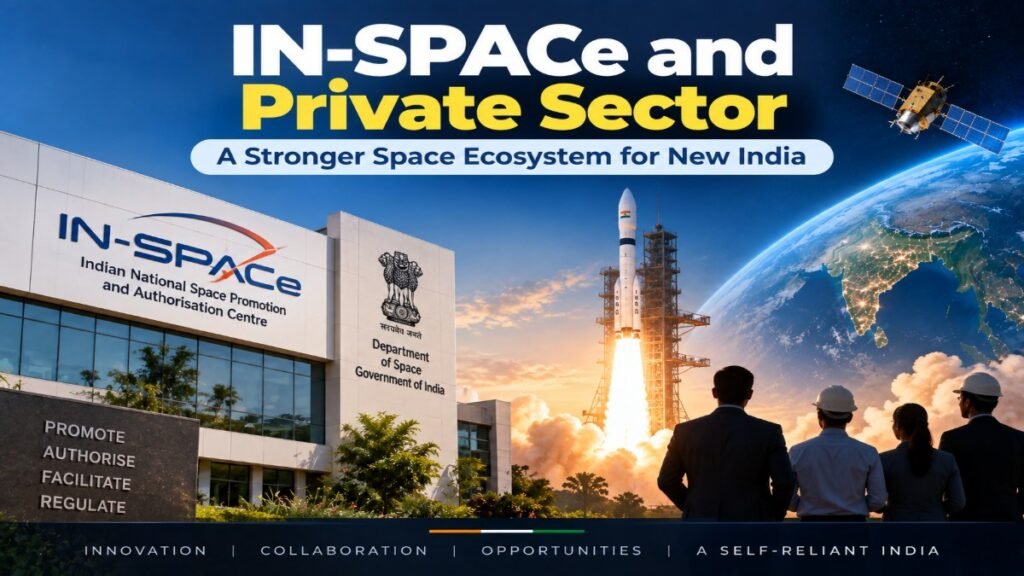
The Indian National Space Promotion and Authorisation Centre (IN-SPACe) is an autonomous agency under the Department of Space (DoS), established in June 2020 to promote, authorize, and regulate the participation of Non-Government Entities (NGEs) in India’s space sector. Its headquarters is located in Ahmedabad, Gujarat. IN-SPACe and Private Sector participation has become an important pillar of India’s evolving space ecosystem.
IN-SPACe serves as the single-window interface between ISRO, the private sector, startups, academia, and government agencies. It was created to implement the Government of India’s vision of opening the space sector to private participation while ensuring that all space activities are carried out in a safe, secure, and transparent manner. This has strengthened the role of the Private Sector in Indian Space Industry.
Following the Indian Space Policy, 2023, IN-SPACe has emerged as the nodal regulatory body responsible for authorizing and supervising end-to-end space activities undertaken by private entities, thereby promoting innovation, commercialization, and the growth of India’s space economy. It is therefore central to Space Sector Regulation in India and the implementation of the Indian Space Policy 2023.
Master Science & Technology. Maximize Your BPSC Mains Score.
Enroll in the BPSC Science & Tech Course Today
Master Science & Technology for BPSC Mains GS Paper-2 with 75+ exam-oriented topics, 6 structured lessons, and downloadable PDF notes—all in one course.
✔ 75+ Exam-Oriented Topics • ✔ 6 Comprehensive Lessons • ✔ Downloadable PDF Notes • ✔ Updated for 72nd BPSC Mains
2. Functions and Role of IN-SPACe
- Single-Window Authorization: IN-SPACe acts as the single-window agency for approving space activities undertaken by private companies, including satellite launches, satellite operations, launch vehicles, launch pads, and ground stations. This helps strengthen Space Sector Regulation in India.
- Promotion of Private Sector Participation: It enables Non-Government Entities (NGEs) to undertake end-to-end space activities, thereby fostering innovation, entrepreneurship, and competition in the Indian space sector. This is central to IN-SPACe and Private Sector participation.
- Technology Transfer and Infrastructure Sharing: IN-SPACe facilitates the transfer of mature technologies developed by ISRO and provides private entities access to ISRO’s testing facilities, launch infrastructure, laboratories, and technical expertise.
- Regulatory Oversight: It ensures that all private space activities comply with national security requirements, public safety standards, international treaties, and India’s obligations under international space law. This regulatory role is important for the effective implementation of the Indian Space Policy 2023.
- Industry Development and Capacity Building: IN-SPACe promotes public-private partnerships (PPP), supports space startups, facilitates investment, and develops industry clusters to strengthen India’s commercial space ecosystem. These measures provide an enabling environment for Space Startups in India.
Prepare Smarter. Study Better. Ace BPSC Mains.
BPSC Mains GS Paper 1 & 2 Complete Course
Access comprehensive BPSC Mains Notes for GS Paper 1 & 2, covering 378+ topics across 24 PDF lessons, with dedicated Bihar coverage, practice questions and downloadable study material.
✓ GS Paper 1 & 2 • ✓ 378+ Topics • ✓ 24 PDF Lessons • ✓ Bihar-Specific Coverage • ✓ Downloadable Notes
3. Significance of IN-SPACe
- Transforms India’s Space Ecosystem: IN-SPACe has shifted India’s space sector from an ISRO-centric model to a collaborative ecosystem where government agencies, private companies, startups, and academia work together. This transformation has strengthened the Private Sector in Indian Space Industry.
- Promotes Commercialization of Space: By enabling private participation in satellite manufacturing, launch services, and space-based applications, IN-SPACe is accelerating the growth of India’s commercial space industry and increasing its global competitiveness.
- Boosts Innovation and Entrepreneurship: Access to ISRO’s technologies and infrastructure has encouraged the emergence of numerous space startups, fostering indigenous innovation and attracting domestic as well as foreign investment. This has provided important support to Space Startups in India.
- Supports National Priorities: While promoting commercialization, IN-SPACe ensures that private space activities align with India’s strategic, security, and developmental objectives, maintaining a balance between commercial growth and national interests.
- Contributes to India’s Space Economy: By creating a transparent and predictable regulatory environment, IN-SPACe is expected to play a crucial role in expanding India’s share in the global space economy and generating high-skilled employment. Its role is closely linked with the broader framework of IN-SPACe and Private Sector participation.
4. Challenges and Way Forward
- Need for a Comprehensive Space Law: India requires a dedicated Space Activities Act to provide legal clarity on licensing, liability, insurance, dispute resolution, and commercial space operations. A comprehensive law would further strengthen Space Sector Regulation in India.
- Strengthen Regulatory Capacity: IN-SPACe should be equipped with greater institutional capacity, technical expertise, and digital systems to efficiently regulate the rapidly expanding private space sector.
- Support Startups and MSMEs: Easier access to funding, testing facilities, technology transfer, and skilled manpower will help Indian space startups compete globally. Such measures can further strengthen Space Startups in India.
- Ensure Ease of Doing Business: Transparent and time-bound approval mechanisms, along with a stable regulatory framework, will encourage greater domestic and foreign investment. This will provide a stronger foundation for IN-SPACe and Private Sector participation.
- Promote International Collaboration: Strengthening partnerships with global space agencies and private companies while ensuring compliance with international obligations will help India emerge as a leading global space hub. This approach is consistent with the objectives of the Indian Space Policy 2023 and can further expand the Private Sector in Indian Space Industry.
5. Conclusion
IN-SPACe has emerged as a key institution in transforming India’s space sector from a predominantly government-led system into a more open and competitive ecosystem. By enabling private participation, supporting startups, facilitating technology access and strengthening regulation, it can accelerate India’s space economy. A robust legal framework, efficient regulation, greater investment and international collaboration will be essential for realizing the full potential of India’s expanding commercial space sector.
BPSC Mains Practice Question
Q. “IN-SPACe represents a paradigm shift from a government-dominated space sector to a collaborative public-private ecosystem.” Discuss its role in promoting private participation, innovation and commercialization in India’s space sector. Also examine the major regulatory challenges that need to be addressed.
Learn More About IN-SPACe
For official information on IN-SPACe, its role in promoting and authorising private participation, regulatory framework, and opportunities for Non-Government Entities (NGEs) in India’s space sector, visit the Indian National Space Promotion and Authorisation Centre (IN-SPACe) official website: IN-SPACe Official Website