1. Illegal Mining: Meaning, Types and Current Scenario
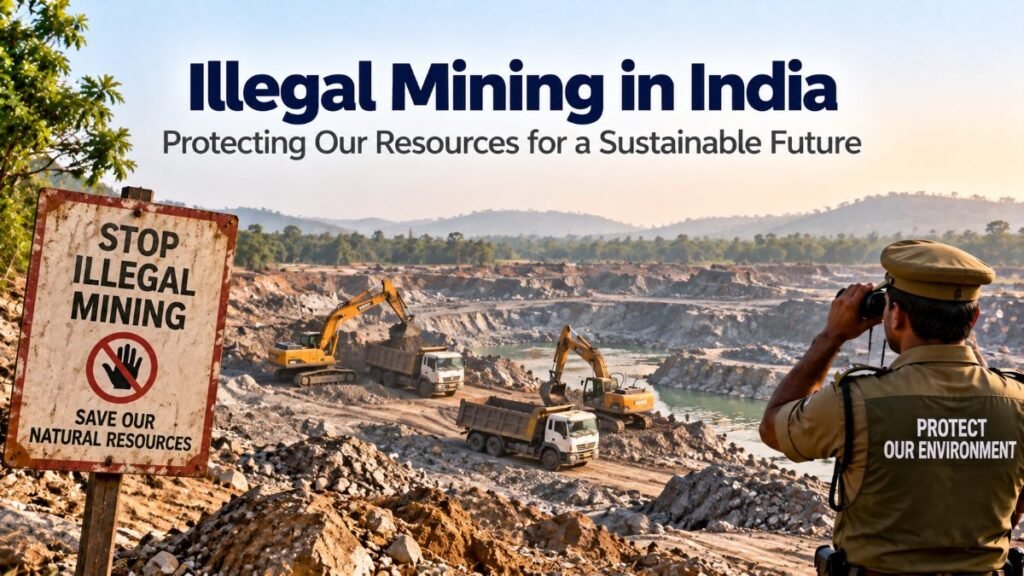
Illegal Mining in India refers to the extraction, transportation, or trade of minerals without valid permits, licenses, or statutory approvals, or in violation of mining and environmental regulations. Illegal Mining in India includes mining beyond the approved lease area, extracting minerals in excess of permitted limits, or operating without complying with environmental and safety norms. Besides causing significant economic losses, Illegal Mining in India poses a serious threat to ecological sustainability and public safety.
Major Types
- Illegal River Sand Mining: Unauthorized extraction of sand from riverbeds for the construction sector. Illegal Sand Mining in India has become a major environmental and governance concern due to rising construction demand.
- Illegal Coal Mining: Unscientific mining in abandoned/unauthorized coal mines, particularly in eastern India.
- Illegal Stone Quarrying: Unregulated extraction of building stones/aggregates from hills and forests.
- Illegal Extraction of Major and Minor Minerals: Iron ore, bauxite, limestone, manganese, etc., without legal permission.
Current Scenario
- India has abundant mineral resources; the Mining in India sector contributes around 2.5% of GDP and supports infrastructure, manufacturing, and energy security.
- Rapid urbanization and demand for construction materials have led to a rise in Illegal Sand Mining in India.
- According to UNEP, sand is the second most exploited natural resource after water, with global demand of around 50 billion tonnes annually.
Bihar Focus: Illegal Sand Mining
Bihar is a major producer of river sand, with mining activities in the Son, Ganga, Punpun, Falgu, Kiul, and Kosi rivers. Illegal Sand Mining in Bihar has emerged as an important environmental, economic, and governance challenge.
The Son River, flowing through Rohtas, Aurangabad, Bhojpur, and Patna, is a major source of construction-grade sand. Excessive or Illegal Mining in India, particularly unregulated sand extraction, causes riverbed deepening, bank erosion, declining groundwater levels, and destruction of aquatic habitats.
Illegal Sand Mining in Bihar is also linked to organized mining mafias, state revenue losses, and law-and-order challenges. Therefore, the issue is not only an environmental problem but also a significant governance challenge.
Master Science & Technology. Maximize Your BPSC Mains Score.
Enroll in the BPSC Science & Tech Course Today
Master Science & Technology for BPSC Mains GS Paper-2 with 75+ exam-oriented topics, 6 structured lessons, and downloadable PDF notes—all in one course.
✔ 75+ Exam-Oriented Topics • ✔ 6 Comprehensive Lessons • ✔ Downloadable PDF Notes • ✔ Updated for 72nd BPSC Mains
2. Environmental Impact of Illegal Mining
Deforestation and Loss of Biodiversity
Illegal Mining in India often requires clearing forests for excavation, roads, and transportation. This leads to deforestation and habitat fragmentation, threatening wildlife and endangered species. Environmental Impact of Mining also includes disruption of wildlife corridors, which can increase human-wildlife conflict.
- According to ISFR 2023, forests cover 21.76% of India’s geographical area.
- Forest clearing for mining and associated infrastructure destroys natural habitats.
- Mining activities can disrupt wildlife corridors and increase human-wildlife conflict.
Soil Erosion and Land Degradation
Unscientific excavation associated with Illegal Mining in India removes fertile topsoil and accelerates soil erosion. Open pits and abandoned mines often become unsuitable for agriculture and afforestation.
- Excavation can remove fertile topsoil and cause soil erosion.
- Open pits and abandoned mines degrade agricultural land.
- Mining activities in hilly areas can increase landslides and slope instability.
- According to ISRO, nearly 30% of India’s geographical area is undergoing land degradation, with mining contributing to the problem.
Water Pollution and Groundwater Depletion
Illegal Mining in India can contaminate rivers and groundwater through sediments, heavy metals, oils, and chemicals. Alteration of natural drainage systems can reduce groundwater recharge and lower the water table.
- Suspended sediments increase water turbidity and affect aquatic biodiversity.
- Polluted water can affect drinking-water sources and irrigation.
- Mining waste can contaminate groundwater and surface-water resources.
- Excessive extraction may alter drainage patterns and reduce groundwater recharge.
River Ecosystem Degradation (Special Focus on Sand Mining)
One of the most significant Environmental Impact of Mining is the degradation of river ecosystems, particularly because of excessive sand extraction.
- Excessive sand removal deepens riverbeds and destabilizes riverbanks.
- Bank erosion can threaten bridges, embankments, agricultural land, and settlements.
- Sand acts as a natural filter and groundwater reservoir; excessive extraction can reduce groundwater recharge and water-table levels.
- Illegal Sand Mining in Bihar can destroy fish and turtle breeding grounds and adversely affect aquatic biodiversity.
Air and Noise Pollution
Mining activities generate PM10 and PM2.5 dust during excavation, crushing, loading, and transportation. Heavy vehicles associated with Illegal Mining in India further increase air pollution, noise pollution, and greenhouse-gas emissions.
- Dust pollution can cause respiratory problems and reduce visibility.
- Heavy vehicles increase noise levels and emissions.
- Noise and vibration can disturb wildlife and affect the quality of life of nearby communities.
According to the UNEP Global Sand Observatory, sand is the second most exploited natural resource after water. This highlights the need for scientific and sustainable sand-mining practices to reduce the Environmental Impact of Mining.
Prepare Smarter. Study Better. Ace BPSC Mains.
BPSC Mains GS Paper 1 & 2 Complete Course
Access comprehensive BPSC Mains Notes for GS Paper 1 & 2, covering 378+ topics across 24 PDF lessons, with dedicated Bihar coverage, practice questions and downloadable study material.
✓ GS Paper 1 & 2 • ✓ 378+ Topics • ✓ 24 PDF Lessons • ✓ Bihar-Specific Coverage • ✓ Downloadable Notes
3. Socio-economic Impact of Illegal Mining
Economic Loss
Illegal Mining in India results in significant economic losses for governments due to the loss of royalties, taxes, and other mining-related revenues. It also promotes an illegal economy and black money.
- Loss of royalty, taxes, and mining revenue.
- Growth of illegal economic activities and black money.
- Reduced availability of funds for public welfare and development.
- Illegal Mining in India causes revenue losses of thousands of crores annually to state governments.
Human Health and Occupational Hazards
Mining workers and nearby communities may be exposed to silica dust, heavy metals, and harmful chemicals. The Environmental Impact of Mining therefore extends beyond ecosystems to human health.
- Exposure to silica dust can cause silicosis and pneumoconiosis.
- Unsafe mining practices can result in accidents and fatalities.
- Lack of adequate safety equipment increases occupational risks.
- Limited access to healthcare further increases the vulnerability of mining workers.
Livelihood and Agricultural Impact
Mining activities can damage agricultural land, reduce groundwater availability, and affect fisheries. Illegal Sand Mining in India is particularly harmful to communities dependent on rivers and agriculture.
- Riverbank erosion and declining groundwater can reduce agricultural productivity.
- Damage to fisheries affects fishermen and river-dependent communities.
- Farmers, fishermen, and workers dependent on sand-related activities may lose their livelihoods.
- In Bihar, Illegal Sand Mining in Bihar along the Son River affects irrigation and agricultural land.
Law and Order
The growth of mining mafias makes Illegal Mining in India a serious law-and-order challenge.
- Mining and sand mafias may operate through organized networks.
- Violence, corruption, and attacks on officials and journalists have been reported.
- Weak governance and the nexus between illegal operators and local networks can facilitate illegal extraction.
- Such activities undermine the rule of law and public confidence in government institutions.
Social and Environmental Justice
The adverse effects of Illegal Mining in India are often disproportionately experienced by tribal communities and economically weaker sections.
- Local communities may face displacement without adequate rehabilitation.
- Tribal and economically weaker communities can be disproportionately affected.
- Child labour and exploitation have been reported in some mining regions.
- Unregulated resource extraction raises concerns about inter-generational equity, as present exploitation can reduce resources and environmental quality available to future generations.
4. Legal Framework and Government Initiatives
MMDR Act, 1957
The Mines and Minerals (Development and Regulation) Act, 1957 (MMDR Act) is the principal legislation governing the regulation and development of mines and minerals in India. It provides the legal framework for mineral extraction and aims to prevent Illegal Mining in India.
- State governments grant mining leases, while the Central Government frames policies and guidelines for mineral development.
- The MMDR Amendment Act, 2021 strengthened enforcement, removed certain restrictions on captive mines, simplified auctions, and promoted greater transparency.
- The Act provides penalties for illegal mining, transportation, and storage of minerals.
Sustainable Sand Mining Management Guidelines, 2016 & Enforcement and Monitoring Guidelines, 2020
The Ministry of Environment, Forest and Climate Change (MoEFCC) issued guidelines to promote scientific and sustainable sand mining and control Illegal Sand Mining in India.
- District Survey Reports (DSRs) are mandatory before granting sand-mining leases.
- Satellite imagery, drones, GPS, RFID, and CCTV are recommended for monitoring mining and transportation activities.
- The guidelines seek to protect river ecosystems while ensuring the availability of construction materials.
- Scientific assessment and monitoring can help reduce the Environmental Impact of Mining.
National Mineral Policy, 2019
The National Mineral Policy, 2019 promotes scientific, sustainable, and environmentally responsible Mining in India.
- Encourages modern technology in mining operations.
- Emphasizes reclamation and restoration of mined-out areas.
- Promotes transparency and ease of doing business while ensuring balanced mineral development.
- Gives importance to community welfare and sustainable resource utilisation.
Pradhan Mantri Khanij Kshetra Kalyan Yojana (PMKKKY)
The PMKKKY uses funds from District Mineral Foundations (DMFs) to improve the lives of people and communities affected by mining. Major areas include:
- Drinking water
- Healthcare
- Education
- Sanitation
- Environmental restoration
- Livelihood development
The scheme seeks to ensure that mineral development benefits local communities and helps reduce the adverse socio-economic impacts associated with mining.
5. Conclusion
Illegal Mining in India highlights the conflict between economic development and environmental sustainability. Mining is indispensable for economic growth, infrastructure development, and energy security, but unregulated and illegal extraction—particularly sand mining—threatens ecological balance, water security, biodiversity, and sustainable livelihoods.
In Bihar, the case of the Son River demonstrates the need for scientific management of sand resources. Illegal Sand Mining in Bihar can cause riverbed degradation, bank erosion, groundwater depletion, and livelihood losses while also creating serious governance and law-and-order challenges. A balanced approach requires:
- Strict enforcement of the MMDR Act, 1957 and sustainable sand-mining guidelines.
- Greater use of drones, GIS, satellite imagery, GPS tracking, and other technologies for monitoring.
- Promotion of sustainable mining practices and alternatives such as manufactured sand (M-Sand).
- Greater community participation in monitoring and reporting illegal activities.
- Ecological restoration through riverbank stabilization, afforestation, and groundwater recharge measures.
- Better coordination among the Mining Department, Pollution Control Board, District Administration, and Police.
Ultimately, sustainable Mining in India requires balancing the demand for minerals with environmental conservation, community welfare, and inter-generational equity. Controlling Illegal Mining in India is therefore essential for inclusive development and the achievement of Sustainable Development Goals (SDGs).
Case Study: Illegal Sand Mining in the Son River, Bihar
Background
The Son River, a major tributary of the Ganga, flows through the districts of Rohtas, Aurangabad, Arwal, Bhojpur, and Patna. It is one of Bihar’s richest sources of construction-grade sand. Rapid urbanization, infrastructure projects, and the real estate boom have sharply increased the demand for sand, resulting in widespread illegal and excessive sand mining, often beyond the limits prescribed under environmental clearances and mining leases.
Issues Involved
- Unregulated extraction of sand from active river channels.
- Mining beyond approved lease areas and permissible depth.
- Illegal transportation and trade of sand by organized mining mafias.
- Weak enforcement, inadequate monitoring, and revenue leakage.
Major Causes
- High demand for sand from the construction and infrastructure sector.
- Large price difference between legally auctioned and illegally extracted sand.
- Inadequate surveillance of river stretches and shortage of enforcement personnel.
- Poor compliance with District Survey Reports (DSRs) and sustainable sand mining guidelines.
- Nexus between illegal operators and local criminal networks.
Major Impacts
Environmental Impact
- Riverbed deepening has altered the natural flow of the Son River.
- Accelerated riverbank erosion, threatening agricultural land and settlements.
- Decline in groundwater recharge due to excessive removal of riverbed sand.
- Destruction of spawning and breeding habitats of fish and other aquatic organisms, resulting in biodiversity loss.
Economic Impact
- Significant loss of royalty and tax revenue to the Government of Bihar.
- Increased expenditure on repairing damaged bridges, embankments, and roads affected by riverbank instability.
- Reduced agricultural productivity due to erosion and declining groundwater availability.
- Distortion of the legal mining market due to unfair competition from illegal operators.
Social Impact
- Loss of livelihood for farmers and fishing communities dependent on the river ecosystem.
- Rise of organized sand mafias, leading to violence, intimidation, and attacks on government officials.
- Increased conflicts between local communities, leaseholders, and enforcement agencies.
- Weakening of public trust in governance due to illegal extraction and corruption.
Health Impact
- Dust generated during excavation and transportation contributes to respiratory problems in nearby villages.
- Heavy movement of overloaded trucks increases road accidents and noise pollution.
- Stagnant water in abandoned mining pits becomes a breeding ground for mosquitoes, increasing the risk of vector-borne diseases.
Suggested Solutions
- Strict enforcement of the MMDR Act, 1957, and the Sustainable Sand Mining Management Guidelines, 2016.
- Preparation and regular updating of District Survey Reports (DSRs) based on scientific assessment of river ecosystems.
- Deployment of drones, satellite imagery, GIS mapping, GPS-enabled vehicle tracking, and CCTV surveillance for real-time monitoring.
- Promotion of Manufactured Sand (M-Sand) as a sustainable alternative to natural river sand.
- Community participation through village vigilance committees and public reporting of illegal mining activities.
- Ecological restoration of degraded river stretches through riverbank stabilization, afforestation, and groundwater recharge measures.
- Strengthening coordination among the Mining Department, Pollution Control Board, District Administration, and Police for effective enforcement.
The Son River illustrates how unchecked sand mining transforms an economic resource into an environmental and governance challenge. It underscores the need to balance infrastructure development with river ecosystem conservation, ensuring that mineral extraction supports sustainable development rather than ecological degradation.
BPSC Mains Practice Questions
- What are the major environmental and socio-economic impacts of illegal mining in India? Discuss the legal and institutional measures required to promote sustainable mining.
- Illegal sand mining in Bihar has emerged as both an environmental and governance challenge. Discuss its major causes and impacts, with special reference to the Son River, and suggest effective measures to address the problem.
Learn More About Illegal Mining in India
For official information on mineral regulation, mining laws, sustainable mining practices, and mineral development in India, visit the Ministry of Mines, Government of India.