1. Introduction
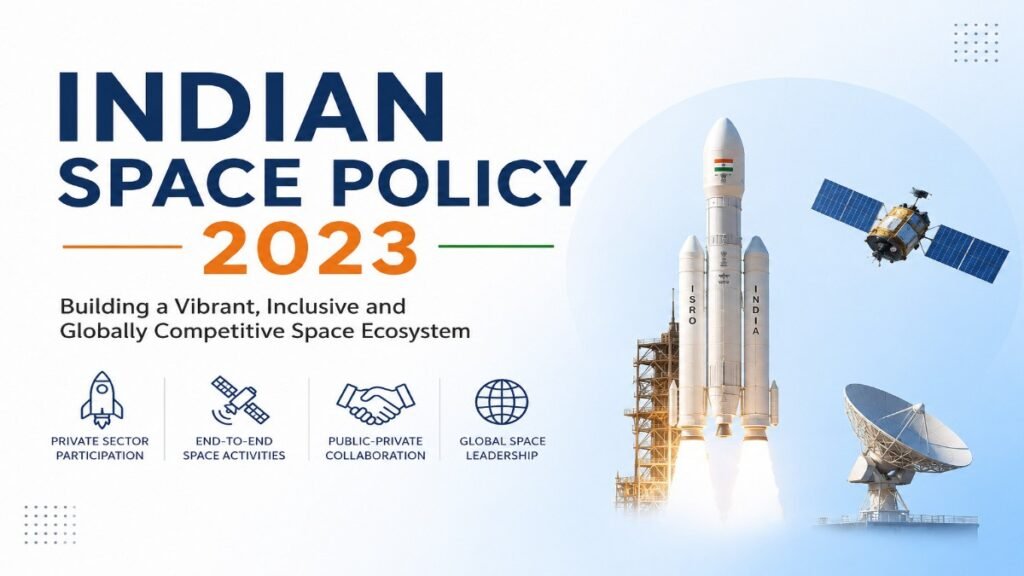
The Indian Space Policy 2023 is a comprehensive policy framework approved by the Union Cabinet on 6 April 2023 to reform India’s space sector by promoting greater participation of private enterprises, enhancing commercial activities and strengthening India’s position in the global space economy.
The policy marks a shift from the earlier ISRO-centric model to a collaborative ecosystem where government agencies, private companies, startups, academia and research institutions work together. While ISRO will focus on advanced research and strategic missions, private entities are allowed to undertake end-to-end space activities, including satellite manufacturing, launch services, satellite operations and space-based applications. This transformation makes the Space Policy of India more innovation-driven, commercially competitive and globally integrated.
Vision of the Policy
“To enable, encourage and develop a flourishing commercial presence in space while ensuring continued government support for national priorities in space.”
The Indian Space Policy 2023 aims to build a vibrant and globally competitive space ecosystem by encouraging innovation, strengthening public-private partnerships and promoting India’s emergence as a leading space power. These Indian Space Policy 2023 BPSC Notes provide a clear understanding of the objectives and vision of the policy and are highly useful for BPSC Mains and other competitive examinations.
Master Science & Technology. Maximize Your BPSC Mains Score.
Enroll in the BPSC Science & Tech Course Today
Master Science & Technology for BPSC Mains GS Paper-2 with 75+ exam-oriented topics, 6 structured lessons, and downloadable PDF notes—all in one course.
✔ 75+ Exam-Oriented Topics • ✔ 6 Comprehensive Lessons • ✔ Downloadable PDF Notes • ✔ Updated for 72nd BPSC Mains
2. Need for the Indian Space Policy 2023
- Expand India’s Share in the Global Space Economy: Despite being one of the leading spacefaring nations, India’s share in the global space economy remains relatively small. The Indian Space Policy 2023 aims to increase India’s participation in the rapidly growing global space market.
- Promote Private Sector Participation: Earlier, private companies were largely limited to supplying components to ISRO. The policy enables Non-Government Entities (NGEs) to undertake end-to-end space activities, fostering innovation, entrepreneurship and greater private investment. This marks a major reform in the Space Policy of India.
- Boost Economic Growth and Employment: A vibrant commercial space ecosystem is expected to attract investment, promote high-technology manufacturing, create skilled jobs and strengthen India’s startup ecosystem.
- Enhance Strategic and National Security: Indigenous development of satellites, launch vehicles and space-based services will reduce dependence on foreign providers and strengthen India’s strategic autonomy and defence preparedness.
- Realise the Vision of Atmanirbhar Bharat: The policy promotes technology transfer, public-private partnerships and commercialisation of space technologies, making India a globally competitive hub for space innovation and services.
The Indian Space Policy 2023 has been introduced not only to strengthen India’s scientific capabilities but also to transform the country’s space sector into a globally competitive, innovation-driven and commercially vibrant ecosystem. These Indian Space Policy 2023 BPSC Notes explain the rationale behind the reforms and are important for BPSC Mains and other competitive examinations.
Prepare Smarter. Study Better. Ace BPSC Mains.
BPSC Mains GS Paper 1 & 2 Complete Course
Access comprehensive BPSC Mains Notes for GS Paper 1 & 2, covering 378+ topics across 24 PDF lessons, with dedicated Bihar coverage, practice questions and downloadable study material.
✓ GS Paper 1 & 2 • ✓ 378+ Topics • ✓ 24 PDF Lessons • ✓ Bihar-Specific Coverage • ✓ Downloadable Notes
3. Key Features of the Indian Space Policy 2023
Rationalised Role of ISRO
Under the Indian Space Policy 2023, ISRO will gradually transition from manufacturing and operational activities to research and development (R&D), advanced technology development, planetary exploration, human spaceflight and strategic national missions. Mature technologies and operational systems will be transferred to industry for commercial utilisation.
IN-SPACe as the Single-Window Regulator
The Indian National Space Promotion and Authorisation Centre (IN-SPACe) has been designated as the single-window agency for promoting, authorising and supervising space activities of Non-Government Entities (NGEs). It provides a level playing field, facilitates technology transfer from ISRO and enables private participation across the entire space value chain. This is one of the most significant reforms introduced under the Space Policy of India.
Enhanced Role of NewSpace India Limited (NSIL)
NewSpace India Limited (NSIL), the commercial arm of ISRO, is responsible for commercialising space technologies, satellite launches, launch services and the transfer of mature technologies developed through public investment. It also facilitates the manufacturing, leasing and procurement of space systems from both public and private sectors.
End-to-End Participation of Private Sector
For the first time, Non-Government Entities (NGEs) are permitted to undertake end-to-end space activities, including the design, manufacture, launch, ownership and operation of satellites and launch vehicles, establishment of launch infrastructure, provision of communication, navigation and remote sensing services, and participation in global commercial space activities.
Strengthened Role of the Department of Space (DoS)
The Department of Space (DoS) will provide overall policy direction, coordinate international cooperation, promote global space governance and facilitate the creation of an appropriate regulatory and dispute-resolution framework for India’s expanding space ecosystem.
These reforms make the Indian Space Policy 2023 a landmark policy aimed at transforming India’s space sector into a globally competitive, innovation-driven and commercially vibrant ecosystem. Understanding these institutional changes is essential for aspirants preparing Indian Space Policy 2023 BPSC Notes, as the features of the Space Policy of India are frequently asked in BPSC Mains and other competitive examinations.
4. Significance of the Indian Space Policy 2023
- Boosts India’s Space Economy: The Indian Space Policy 2023 is expected to accelerate the growth of India’s commercial space sector by encouraging private investment, increasing exports and enhancing India’s share in the global space economy.
- Promotes Innovation and Startups: By opening the space sector to Non-Government Entities (NGEs), the policy provides a major boost to space start-ups, private industries and research institutions, fostering innovation, entrepreneurship and technological advancement.
- Strengthens Self-Reliance (Atmanirbhar Bharat): Greater indigenous development of satellites, launch vehicles, space applications and related technologies will reduce dependence on foreign countries and strengthen India’s technological capabilities. This is one of the key objectives of the Space Policy of India.
- Enhances National Security: Increased participation of domestic industries in developing communication, navigation, remote sensing and surveillance technologies will improve India’s strategic preparedness and space security.
- Generates Employment and Investment: Expansion of the private space ecosystem is expected to attract domestic and foreign investment, promote high-technology manufacturing and create large-scale employment opportunities.
- Improves Global Competitiveness: The policy aligns India’s space sector with global best practices and strengthens the country’s position as an emerging hub for affordable launch services, satellite manufacturing and space-based applications.
The Indian Space Policy 2023 represents a major shift from a government-driven space programme to a collaborative ecosystem involving government, industry, start-ups and academia. By promoting commercialisation, innovation and self-reliance, the policy is expected to strengthen India’s position as a leading global space power. These Indian Space Policy 2023 BPSC Notes highlight the importance of the policy and are highly relevant for BPSC Mains and other competitive examinations.
5. Challenges and Concerns
- Need for a Comprehensive Space Law: Although the Indian Space Policy 2023 provides a broad framework, India still requires a Space Activities Act to clearly define licensing, liability, insurance, dispute resolution and regulatory oversight.
- Regulatory and Institutional Challenges: IN-SPACe requires a robust legal and regulatory framework to effectively discharge its responsibilities as the single-window authorisation and promotion agency under the Space Policy of India.
- Technology and Infrastructure Gaps: Indian private companies, particularly start-ups, require greater access to advanced technologies, testing facilities, funding and skilled human resources to compete globally.
- Balancing Commercial and Strategic Interests: While promoting commercialisation, the government must ensure that national security, strategic space assets and sensitive technologies remain adequately protected.
- Global Competition: Indian space companies face intense competition from established international players, making continuous innovation, cost competitiveness and policy support essential.
These challenges indicate that the success of the Indian Space Policy 2023 will depend not only on policy reforms but also on the creation of a strong legal framework, efficient regulatory institutions and a globally competitive private space ecosystem. Addressing these concerns is essential to realise the policy’s objective of making India a leading space power. These Indian Space Policy 2023 BPSC Notes also highlight the critical issues associated with the implementation of the Space Policy of India, making this section highly relevant for BPSC Mains.
6. Way Forward
- Enact a Comprehensive Space Activities Act: A dedicated legislation should be enacted to provide legal certainty on licensing, liability, insurance, dispute resolution and the regulation of private space activities under the Indian Space Policy 2023.
- Strengthen IN-SPACe and the Regulatory Ecosystem: IN-SPACe should be empowered with adequate institutional capacity, transparent procedures and a predictable regulatory framework to facilitate ease of doing business in the space sector.
- Promote Private Investment and Innovation: Greater financial incentives, technology transfer, public-private partnerships (PPP) and access to ISRO’s infrastructure should be provided to start-ups and industries to accelerate innovation. This will further strengthen the implementation of the Space Policy of India.
- Enhance International Collaboration: India should expand cooperation with leading space agencies and encourage participation in global space missions while safeguarding national interests.
- Develop a Globally Competitive Space Ecosystem: Continued investment in research, advanced manufacturing, skilled workforce development and indigenous technologies will help India achieve its ambition of becoming a leading global space power and significantly increase its share in the global space economy.
The successful implementation of the Indian Space Policy 2023 requires a balanced approach that combines strong regulation, greater private participation, technological innovation and international cooperation. By creating a globally competitive and innovation-driven space ecosystem, India can strengthen its strategic capabilities, accelerate economic growth and emerge as a major player in the global space economy. These Indian Space Policy 2023 BPSC Notes provide a comprehensive understanding of the future roadmap of the Space Policy of India and are highly useful for BPSC Mains and other competitive examinations.
Learn More from ISRO:
Readers interested in understanding the Indian Space Policy 2023, its objectives, institutional framework, roles of ISRO, IN-SPACe, NSIL and the Department of Space (DoS), as well as provisions relating to private sector participation and commercialisation of the space sector, can refer to the official Indian Space Policy 2023 published by the Indian Space Research Organisation (ISRO). It provides the complete policy document and authentic information on the Space Policy of India.
BPSC Mains Practice Questions
Q1. Discuss the salient features of the Indian Space Policy 2023. How does the policy seek to transform India’s space sector through greater private sector participation while ensuring national strategic interests?
Q2. Examine the significance of the Indian Space Policy 2023 in promoting innovation, self-reliance and the growth of India’s space economy. Also discuss the major challenges in its effective implementation.